# Sovereign Grace and the Bond Will
### A Reformed Case for Free Agency, Total Depravity, and Compassionate Calvinism
*A Series By Adam Malin*
*Date: December 7, 2025*
[Audio Overview](https://notebooklm.google.com/notebook/abe3e7f0-5d96-47f2-b8db-94c23ee1438b?artifactId=94c56cf9-8082-4aa5-ba61-bcfd4a16f59a)
[Video Overview](https://youtu.be/lwviqZiXEzU)
## Introduction
Why do people keep flying into the same flames even when they see the fire coming?
We watch loved ones return to addictions, lies, and self-destruction “like a moth to the flame.” We watch ourselves repeat patterns we hate. Yet Scripture never lowers the bar of responsibility:
> “Choose you this day whom ye will serve.” (Joshua 24:15)
> “Repent ye, and believe the gospel.” (Mark 1:15)
How can the Bible command real choice, and at the same time describe us as slaves of sin and dead in trespasses?
Classic Reformed theology, following Scripture and summarized in the Westminster Confession, answers like this:
- God is absolutely sovereign and decrees whatsoever comes to pass.
- Man, in Adam, is totally depraved and morally unable to turn to God.
- Man is still a real, responsible agent who chooses voluntarily.
- Saving grace does not violate the will; it **liberates** it.
This essay unfolds that logic from Scripture (KJV), using the Reformed distinction between **natural liberty** and **moral bondage**, and drawing pastoral implications for how we view our own sin and the sins of others.
---
## 1. God the First Cause: Decree and Providence
Biblical teaching about the will must begin with God, not man.
> “For of him, and through him, and to him, are all things: to whom be glory for ever. Amen.” (Romans 11:36)
> “In whom also we have obtained an inheritance, being predestinated according to the purpose of him **who worketh all things after the counsel of his own will**.” (Ephesians 1:11)
God is not a mere spectator, foreseeing what will happen. He is the **First Cause**, freely and wisely ordaining “whatsoever comes to pass” (WCF 3.1). Even the details of our existence are governed by His providence:
> “And hath made of one blood all nations of men for to dwell on all the face of the earth, and hath **determined the times before appointed, and the bounds of their habitation**.” (Acts 17:26)
Yet, the Confession immediately adds:
> God ordains all things “*yet so, as thereby neither is God the author of sin, nor is violence offered to the will of the creatures…*” (WCF 3.1)
He executes His decree through **secondary causes**—creatures who think, desire, and act. This is often called **concurrence**: God upholds and orders the act; the creature supplies the defect and the evil. His sovereignty does not erase our agency; it grounds it.
---
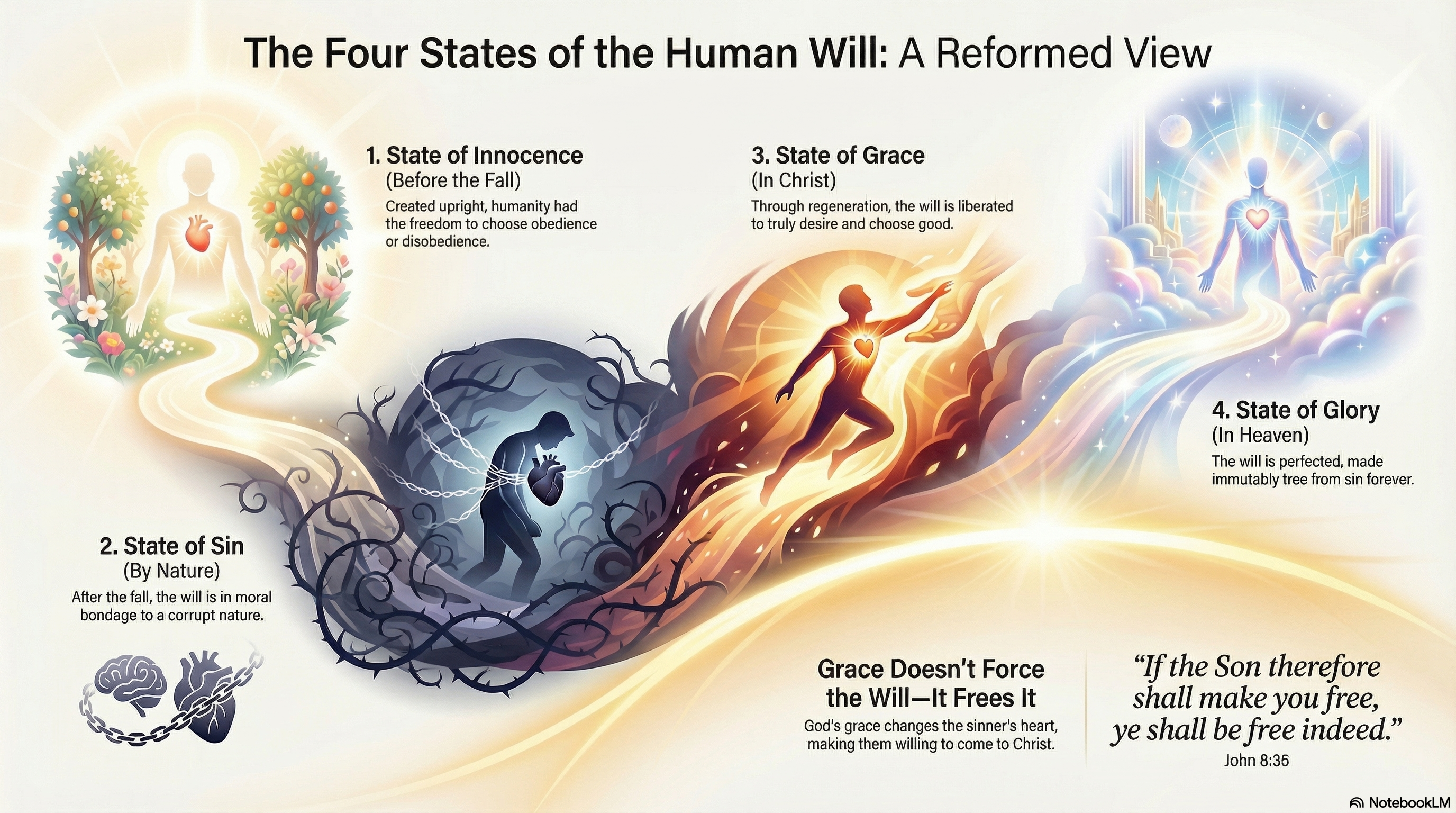
## 2. The Fourfold State of Man
To answer, “Do we have free will?” we must ask, **“Which man?”**
Reformed theology, following Augustine, speaks of four states:
1. **State of Innocence (before the fall)**
Man was created “upright” (Ecclesiastes 7:29), with true freedom to obey or disobey.
> “Of every tree of the garden thou mayest freely eat:
> But of the tree of the knowledge of good and evil, thou shalt not eat of it…” (Genesis 2:16–17)
Adam had:
- *posse peccare* – able to sin
- *posse non peccare* – able not to sin
2. **State of Sin (after the fall, by nature)**
This is the condition of all men by nature in Adam.
- *non posse non peccare* – not able not to sin
We are not stripped of the faculty of willing, but the heart is now corrupt, and the will is in bondage to that corruption.
3. **State of Grace (after regeneration)**
In Christ, the believer is renewed so as really to will and to do what is spiritually good, though the flesh remains.
- *posse non peccare* – able not to sin
4. **State of Glory (in heaven)**
At last, the believer is perfectly and immutably freed from sin.
- *non posse peccare* – not able to sin
This framework guards us from speaking vaguely about “free will.” Our answer must always be: **Which state? Which man?**
---
## 3. Total Depravity: Not Utter, but Real and Total
In the **state of sin**, man is not as bad as he could possibly be every moment (utter depravity), but he is **totally depraved**—every part of his nature is tainted by sin, and he is unable to turn himself to God.
Paul’s indictment is sweeping:
> “As it is written, There is none righteous, no, not one:
> There is none that understandeth, **there is none that seeketh after God**.” (Romans 3:10–11)
> “And you hath he quickened, **who were dead in trespasses and sins**;
> …fulfilling **the desires of the flesh and of the mind**; and were by nature the children of wrath, even as others.” (Ephesians 2:1, 3)
Jesus describes this condition as slavery:
> “Whosoever committeth sin is **the servant of sin**.” (John 8:34)
The “natural man” does not and *cannot* receive the things of God:
> “But the natural man receiveth not the things of the Spirit of God: for they are foolishness unto him: **neither can he know them**, because they are spiritually discerned.” (1 Corinthians 2:14)
> “Because the carnal mind is **enmity against God**: for it is not subject to the law of God, **neither indeed can be**. So then they that are in the flesh **cannot please God**.” (Romans 8:7–8)
So, the fallen will is not destroyed, but it is **morally bound**. We still choose; but our choosing faculty is not neutral—it follows a heart that is at enmity with God.
---
## 4. Free Agency: Natural Liberty vs. Moral Bondage
Reformed theology is cautious with the phrase **“free will”** because it can suggest an autonomous, self-originating power. It prefers to speak of **free agency** or **natural liberty**.
The Westminster Confession says:
> “God hath endued the will of man with that natural liberty, that it is neither forced, nor, by any absolute necessity of nature, determined to good, or evil.” (WCF 9.1)
In other words:
- **Natural Liberty** – We are not coerced like stones or puppets. We act voluntarily, out of our own desires.
- **Moral Inability** – In the state of sin, those desires are corrupt, so we **cannot** want God as God, or come to Christ in faith.
This is why Jesus says:
> “No man **can** come to me, except the Father which hath sent me draw him…” (John 6:44)
The problem is not lack of permission, but lack of *power and desire*. Our “wanter” is broken. The bad tree cannot bring forth good fruit (Matthew 7:18).
So in the state of sin:
- We are **free agents**—choosing what we want.
- We are **not morally free** to want God rightly.
Left to ourselves, we will never choose Christ savingly. Our will is free in the sense of spontaneity, but bound in the sense of moral direction.
---
## 5. Compatibilism in Scripture: Two Causes, One Event
Scripture never solves the tension between God’s absolute sovereignty and man’s real responsibility by diminishing either side. It insists on both together.
### Joseph and His Brothers
After years of suffering, Joseph can say:
> “But as for you, **ye thought evil against me; but God meant it unto good**, to bring to pass, as it is this day, to save much people alive.” (Genesis 50:20)
Same event; two intentions:
- **“Ye thought evil”** – real human intention and guilt.
- **“God meant it unto good”** – real divine intention and decree.
God did not merely *use* their evil afterwards. He “meant” the same event for a good purpose, yet they remain culpable.
### The Crucifixion
Peter declares:
> “Him, being **delivered by the determinate counsel and foreknowledge of God**, **ye have taken**, and by **wicked hands** have crucified and slain.” (Acts 2:23)
Again:
- Christ is delivered by God’s determined counsel.
- Yet those who killed Him acted with “wicked hands.”
This is **compatibilism** in biblical form: God is the primary cause; man is the secondary cause. God’s decree does not cancel human agency; it ensures it.
---
## 6. Habits, “Neurological Patterns,” and Besetting Sin
Modern language about “neurological patterns” is not far from Scripture’s language of **habit**, **indwelling sin**, and **besetting sin**.
Hebrews speaks of:
> “…the sin which doth so easily beset us…” (Hebrews 12:1)
Paul laments:
> “For the good that I would I do not: but the evil which I would not, that I do.” (Romans 7:19)
Repeated choices become grooves; grooves become chains. People return to familiar sins even when they see them coming. Knowledge alone does not liberate the will.
Yet Scripture still locates responsibility in the person:
> “But every man is tempted, when he is drawn away **of his own lust**, and enticed. Then when lust hath conceived, it bringeth forth sin…” (James 1:14–15)
The lust is *his own*. We are not passive victims of our brain chemistry. Our “patterns” expose the deeper reality of the heart, which we cannot heal, but which God holds us responsible for.
This should not make us fatalistic; it should make us desperate for grace, and more empathetic toward other sinners.
---
## 7. Federal Headship and Imputed Guilt: Why No One Is Innocent
You noted that “man is never innocent.” Scripture agrees.
By nature we stand not only corrupt, but also **guilty** before God, even before we commit actual sins, because of **imputed guilt** from Adam.
> “Wherefore, as by **one man** sin entered into the world, and death by sin; and so death passed upon all men, **for that all have sinned**.” (Romans 5:12)
> “Therefore as by the offence of one judgment came upon all men to condemnation…” (Romans 5:18)
Adam stood as our **federal head**. When he fell, we fell in him. Thus:
- We bear **imputed guilt** – Adam’s guilt legally reckoned to us.
- We inherit **corruption** – a sinful nature (Psalm 51:5).
So vertically, before God, no one is morally “innocent.” Horizontally, in human courts, someone may be “innocent” of a particular charge—but that does not mean sinless before God’s law.
We are not sinners because we occasionally sin; we sin because we are sinners.
---
## 8. Effectual Calling and Regeneration: Grace Changes the Chooser
If the will in the state of sin is really in bondage, then the first decisive move in salvation cannot come from man. It must come from God.
Jesus says:
> “Except a man be born again, he cannot see the kingdom of God.” (John 3:3)
John clarifies:
> “Which were born, **not of blood, nor of the will of the flesh, nor of the will of man, but of God**.” (John 1:13)
God Himself promises:
> “A new heart also will I give you, and a new spirit will I put within you: and I will take away **the stony heart** out of your flesh, and I will give you an heart of flesh.
> And I will put my spirit within you, and **cause you to walk in my statutes**, and ye shall keep my judgments, and do them.” (Ezekiel 36:26–27)
This is **monergistic regeneration** and **effectual calling**. God, by His Spirit, inwardly, powerfully, and graciously renews the heart of the elect so that they truly and freely come to Christ.
Psalm 110:3 summarizes:
> “Thy people shall be willing in the day of thy power…” (Psalm 110:3)
Grace does not drag an unwilling sinner into heaven. It **makes the sinner willing** by changing the heart from enmity to love.
---
## 9. Sanctification: Real Progress, Real Struggle
Once regenerated and justified, believers enter the **state of grace**. They now have a renewed will and a new principle of life, but indwelling sin remains.
Paul’s experience is not an outlier:
> “O wretched man that I am! who shall deliver me from the body of this death?” (Romans 7:24)
We are commanded:
> “And be not conformed to this world: but be ye **transformed by the renewing of your mind**…” (Romans 12:2)
And yet this transformation is grounded in God’s ongoing work:
> “Work out your own salvation with fear and trembling.
> For it is God which worketh in you both **to will and to do** of his good pleasure.” (Philippians 2:12–13)
So:
- We **really fight** against old patterns.
- God **really works** in us at the level of both desire (“to will”) and action (“to do”).
Sanctification is imperfect in this life (WCF 13). The “moth to the flame” tendencies do not vanish overnight. But they are no longer absolute masters. The believer is no longer a slave to sin (Romans 6:14). The Spirit, through Word, sacrament, prayer, and fellowship, is steadily rewiring the soul for obedience and joy.
---
## 10. Christ’s Obedience and Intercession: Our Only Righteousness
Because sin is “any want of conformity unto, or transgression of, the law of God” (WSC 14), and because we are guilty in Adam and polluted in ourselves, we have **no innocence** to plead before God.
Our hope rests entirely on Christ:
> “For he hath made him to be sin for us, who knew no sin; that we might be made **the righteousness of God in him**.” (2 Corinthians 5:21)
> “Therefore being justified by faith, we have peace with God through our Lord Jesus Christ.” (Romans 5:1)
Christ’s:
- **Active obedience** – His perfect keeping of the law.
- **Passive obedience** – His suffering the penalty of the law.
are imputed to us by faith. And the risen Christ now **intercedes** for us:
> “It is Christ that died, yea rather, that is risen again, who is even at the right hand of God, **who also maketh intercession for us**.” (Romans 8:34)
> “Wherefore he is able also to save them **to the uttermost** that come unto God by him, seeing he ever liveth to make intercession for them.” (Hebrews 7:25)
We are never innocent in ourselves. In Christ, we are fully accepted and forever secure.
---
## 11. Pastoral Fruit: Humility, Empathy, and Truth in Love
A robust doctrine of sovereign grace and a bound will should not make us harsh; it should make us **lowly, gentle, and bold in love**.
### 11.1 It Kills Pride
We did not make ourselves to differ:
> “For who maketh thee to differ from another? and what hast thou that thou didst not receive? now if thou didst receive it, why dost thou glory, as if thou hadst not received it?” (1 Corinthians 4:7)
### 11.2 It Deepens Empathy
We view sinners not as mere idiots who “just need to make better choices,” but as captives:
> “…that they may recover themselves out of **the snare of the devil**, who are **taken captive by him at his will**.” (2 Timothy 2:26)
And we remember:
> “For we ourselves also were sometimes foolish, disobedient, deceived, serving divers lusts and pleasures…” (Titus 3:3)
This does not excuse their sin, but it makes our tone softer, our patience longer, and our tears more ready.
> “And the servant of the Lord **must not strive; but be gentle unto all men**, apt to teach, patient,
> In meekness instructing those that oppose themselves…” (2 Timothy 2:24–25)
### 11.3 It Strengthens Truth-telling
Because only the Spirit can free the will, we do not trust in manipulation or moralism. We preach Christ, call for repentance, and speak the truth in love (Ephesians 4:15), knowing that God alone gives “repentance to the acknowledging of the truth” (2 Timothy 2:25).
On the cross, Christ models this balance:
> “Father, forgive them; for **they know not what they do**.” (Luke 23:34)
They truly sinned. They truly did not know the full weight of their act. He truly loved them. That is the tone Calvinism ought to produce.
---
## 12. Conclusion: Responsible Rebels, Free by Grace
According to Reformed theology:
- In ourselves, we are **responsible rebels**—guilty in Adam, corrupt by nature, choosing sin freely yet inevitably according to our fallen hearts.
- We are never autonomous choosers, never morally neutral, never innocent.
- We are also never mere victims of environment or “wiring.”
Our only hope is the sovereign, electing, regenerating, justifying, preserving grace of God in Christ:
> “There is therefore now no condemnation to them which are in Christ Jesus…” (Romans 8:1)
> “If the Son therefore shall make you free, ye shall be free indeed.” (John 8:36)
Soli Deo gloria.