# Exegesis First: Case Studies that Correct Dispensational Eisegesis
*A Series By Adam Malin*
*Date: August 29, 2025*
[Audio Overview](https://notebooklm.google.com/notebook/44b35a25-44e5-4387-9973-8db35b60bd5b?artifactId=a1084067-a366-4d6e-8cad-7226973faeb4)
[Video Overview](https://youtu.be/PwowehpCJZA)
---
## What Is *Exegesis* (and Why It Matters)
> “**Study to shew thyself approved unto God, a workman that needeth not to be ashamed, rightly dividing the word of truth.**” (2 Timothy 2:15)
> “**These were more noble… in that they received the word with all readiness of mind, and searched the scriptures daily, whether those things were so.**” (Acts 17:11)
> “**Knowing this first, that no prophecy of the scripture is of any private interpretation. For the prophecy came not in old time by the will of man: but holy men of God spake as they were moved by the Holy Ghost.**” (2 Peter 1:20–21)
> “**Add thou not unto his words**, lest he reprove thee, and thou be found a liar.” (Proverbs 30:5–6; cf. Deuteronomy 4:2)
> “So they read in the book in the law of God distinctly, and **gave the sense**, and caused them to understand the reading.” (Nehemiah 8:8)
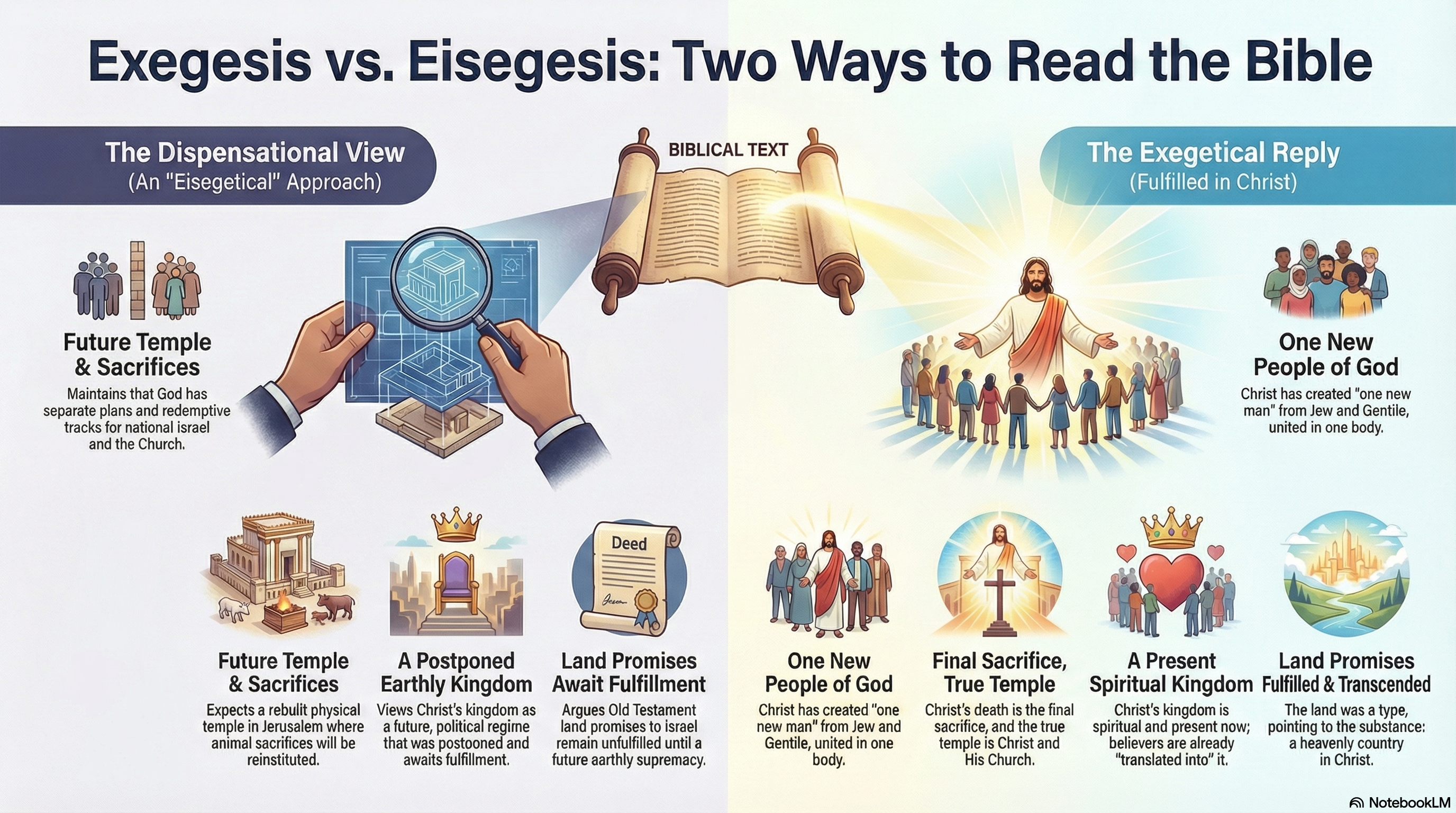
Scripture itself requires an exegetical ministry. Exegesis draws out the Spirit-intended meaning from the God-breathed text—attending to words, grammar, literary form, historical setting, and canonical context—so that the church may “rightly divide the word of truth” (2 Timothy 2:15; 2 Timothy 3:16–17). Eisegesis, by contrast, imposes a foreign system onto the passage, “adding” to God’s words and multiplying error (Proverbs 30:5–6).
The apostolic pattern establishes the controls of sound interpretation:
* **Scripture interprets Scripture.** The Spirit teaches “comparing spiritual things with spiritual” (1 Corinthians 2:13); the apostles join passage to passage (Acts 15:15–17).
* **The clear governs the hard.** The unstable wrest what is “hard to be understood” (2 Peter 3:16); therefore obscure texts yield to plainer ones.
* **Genre and redemptive-historical location matter.** God “at sundry times and in divers manners spake… by the prophets,” but “in these last days… by his Son” (Hebrews 1:1–2). Types and shadows point forward and are fulfilled in Christ (Hebrews 8:5; 10:1; Colossians 2:17; Luke 24:27, 44).
* **The covenantal storyline is one.** From the first gospel promise to the blood of the everlasting covenant, redemption is in Christ the Mediator (Genesis 3:15; Galatians 3:8, 16, 29; Luke 22:20; Hebrews 13:20).
### A Simple Path (positively stated)
1. **Read the words carefully.** Attend to repetition, structure, and grammar; the apostles build arguments on details such as number and tense (Galatians 3:16; Matthew 22:31–32).
2. **Honor genre and authorial aim.** Distinguish narrative, poetry, prophecy, wisdom, Gospel, Epistle, and apocalyptic; apocalyptic visions are “signified” (Revelation 1:1), while didactic passages norm doctrine (1 Timothy 3:14–15).
3. **Trace the context.** Move from clause to paragraph to book, then place the text within its covenantal moment and the progression of revelation (Nehemiah 8:8; Hebrews 9:10; Galatians 4:4; Hebrews 1:1–2).
4. **Compare Scripture with Scripture.** Let the many illuminate the one: promises, types, and prophecies fulfilled in Christ interpret prior shadows (Acts 15:15–18; Luke 24:27; Hebrews 10:1). Use the **clear** to illumine the **obscure** (2 Peter 3:16).
5. **Keep the covenantal frame.** Recognize the **Covenant of Works** with Adam (Genesis 2:16–17; Romans 5:12–19; 1 Corinthians 15:22) and the **Covenant of Grace** fulfilled in Christ for Jew and Gentile alike (Genesis 3:15; Galatians 3:8, 29; Ephesians 2:11–22; Hebrews 13:20).
6. **Apply with humility and obedience.** Doctrine and practice flow from the text, not from preference; the Word equips for “all good works,” and hearers must be doers (2 Timothy 3:16–17; James 1:22; Psalm 19:7–11).
*Result:* This method—explicitly modeled by the apostles—guards the church from eisegesis and prepares the way for the case studies that follow, where the promises, types, and shadows are shown to reach their substance in Christ and His church (Luke 24:27, 44; Ephesians 1:9–10).
### Red Flags of Eisegesis (put negatively)
* Starting with conclusions and hunting verses (proof‑texting).
* Importing current debates so strongly that they steer meaning.
* Ignoring genre/structure; flattening the canon; building doctrine on obscure texts while neglecting plain ones.
> **Pastoral note.** Many of us learned to love the Bible from Dispensational teachers. Our aim here is **clarity without caricature**—to show where Scripture itself redirects us.
---
## Case Study 1 — **Hebrews 8–10: No Return to Temple Sacrifices**
**Thesis (apostolic, didactic, final):** Hebrews declares the finality and sufficiency of Christ’s priesthood and sacrifice. The change of priesthood to Christ entails a change of law; the former commandment concerning Levitical sacrifice is **“disannulled”** for weakness and unprofitableness, because perfection comes in Christ alone (Hebrews 7:12, 18–19). By instituting the **New Covenant**, God **“made the first old”** (Hebrews 8:13). Christ, the greater Priest, **“by his own blood… entered in once… having obtained eternal redemption”** (Hebrews 9:11–12). Therefore, **“by one offering he hath perfected for ever them that are sanctified,”** and **“where remission… is, there is no more offering for sin”** (Hebrews 10:10, 14, 18).
**Dispensational claim:** A future Jerusalem temple will reintroduce animal sacrifices (commonly as non-propitiatory “memorials”).
**Where the eisegesis occurs:** Symbol-laden temple visions (e.g., Ezekiel 40–48) are allowed to relativize or override the plain, didactic argument of Hebrews. This inverts the apostolic hermeneutic, which subordinates shadow to substance and visionary symbol to Christ’s finished work (Hebrews 8:5; 10:1; Colossians 2:17; Luke 24:27, 44).
**Exegetical demonstration (Scripture interprets Scripture):**
* **Change of priesthood ⇒ change of law.** With priesthood transferred to Christ after the order of Melchizedek, the sacrificial legislation bound to Levi is terminated (Hebrews 7:12, 18–19).
* **Old made obsolete by the New.** The first covenant, with its cultus, is declared **old**, ready to vanish; its earthly sanctuary and rites were temporary, **“imposed… until the time of reformation”** (Hebrews 8:13; 9:1, 9–10).
* **Once-for-all sacrifice.** Christ’s entrance **once** with His own blood contrasts with repeated animal offerings that could never perfect the conscience (Hebrews 9:11–12; 10:1–4, 10, 14, 18).
* **Shadow to substance.** The tabernacle service was a **“figure”** and **“shadow”**; resurrecting blood-sacrifice—whether styled “memorial” or otherwise—reinstates the shadow against the apostolic verdict: **“no more offering for sin”** (Hebrews 9:9; 8:5; 10:18).
* **Temple fulfillment in Christ and His church.** Jesus identifies His body as the true temple (John 2:19–21). By the Spirit, the church becomes the living temple, **“an habitation of God”** (Ephesians 2:19–22; 1 Peter 2:5). This Christological and ecclesial fulfillment guards Ezekiel’s vision from being pressed into a literal re-sacralization of animal blood.
**Doctrinal conclusion (Westminster logic):** The once-for-all oblation of Christ, with His continual, effectual intercession, accomplishes and applies redemption to the elect and renders all propitiatory offerings obsolete. By the apostolic method, a return to sacrificial blood—however denominated—contradicts the New Covenant’s finality.
**Main takeaway:** **Christ’s cross closed the sacrificial economy; to return to blood is to return to shadows.**
---
## Case Study 2 — **Ephesians 2–3: One New Man, One Household**
**Thesis (apostolic, ecclesiological unity):** In Christ, Jew and Gentile are created **“one new man”**, reconciled **“in one body”**, made **“fellowcitizens… and of the household of God,”** and built into **one** holy temple by the Spirit (Ephesians 2:14–22; 3:6).
**Dispensational claim:** God maintains two parallel covenant peoples (Israel and the Church) with separate redemptive tracks.
**Where the eisegesis occurs:** A pre-committed Israel/Church partition is read **into** a text whose grammar emphasizes **one**: one new man (2:15), one body (2:16), one household (2:19), one temple (2:21–22).
**Exegetical demonstration (Scripture interprets Scripture):**
* **Wall removed, not rebuilt.** Christ **“is our peace”**, having **“broken down the middle wall of partition”** and **“abolished… the law of commandments contained in ordinances”** to **“make in himself of twain one new man”** and reconcile both **“in one body”** (Ephesians 2:14–16).
* **Commonwealth and citizenship redefined in Christ.** Those **“aliens from the commonwealth of Israel”** are now **“fellowcitizens with the saints”** (Ephesians 2:12, 19). The apostolic move is not two tracks but one polity in Christ.
* **One foundation, one temple-people.** The church is **“built upon the foundation of the apostles and prophets, Jesus Christ himself being the chief corner stone,”** the whole structure growing into **“an holy temple in the Lord”** (Ephesians 2:20–22).
* **The mystery revealed.** The “mystery” is that **“the Gentiles should be fellowheirs, and of the same body, and partakers of his promise in Christ by the gospel”** (Ephesians 3:6). This accords with the Abrahamic promise realized in Christ, where **“if ye be Christ’s, then are ye Abraham’s seed, and heirs according to the promise”** (Galatians 3:16, 29; cf. Acts 15:14–18; Romans 11:17–24).
**Doctrinal conclusion (Westminster logic):** The covenant of grace yields **one** visible household under Christ the Mediator. The apostolic hermeneutic rules out a re-erected partition between Israel and the Church; unity in Christ is the divinely revealed design.
**Main takeaway:** **Paul asserts one reconciled people, not parallel tracks—one new man, one household, one temple in Christ.**
---
## Case Study 3 — **Galatians 3: Who Is Abraham’s Seed?**
**Thesis (apostolic, Christocentric reading):** Paul identifies the promised **Seed** as **Christ**, and declares that all united to Christ by faith are Abraham’s seed and heirs according to promise (Galatians 3:16, 26–29).
**Dispensational claim:** Inheritance tracks with **ethnicity**.
**Where the eisegesis occurs:** “Seed” is treated as a merely biological line, despite Paul’s explicit, grammatical focus on **the singular**—**“to thy seed, which is Christ”**—and his union-with-Christ conclusion for Jew and Gentile alike (Galatians 3:16, 28–29).
**Exegetical demonstration (Scripture interprets Scripture):**
* **Seed singular → Christ.** Paul grounds his argument in the number of the noun: the promise was spoken “to Abraham and his seed… which is Christ” (Galatians 3:16; cf. Genesis 12:7; 13:15; 22:18).
* **Promise, not law, secures inheritance.** The law, coming four hundred and thirty years after, cannot annul the previously ratified covenant; inheritance is **of promise** (Galatians 3:17–18).
* **Faith-union creates true heirs.** Those of faith are **“the children of Abraham,”** as God “preached before the gospel unto Abraham, saying, In thee shall all nations be blessed” (Galatians 3:7–9). Baptized into Christ, believers “have put on Christ,” and so “there is neither Jew nor Greek… for ye are all one in Christ Jesus” (Galatians 3:27–28).
* **Conclusion stated.** “If ye be Christ’s, then are ye Abraham’s seed, and heirs according to the promise” (Galatians 3:29; cf. Romans 4:11–13; Ephesians 2:11–22).
**Doctrinal conclusion (Westminster logic):** By covenantal continuity, Abraham’s inheritance is Christ and the blessings in Him; therefore the heirs are all who are in Christ by faith, irrespective of ethnicity. The apostolic method terminates the question in Christ the Mediator and His one covenant people.
**Main takeaway:** **Inheritance is in Christ, not in bloodline.**
---
## Case Study 4 — **Acts 15 (Amos 9): David’s Tent Rebuilt—Now**
**Thesis (apostolic application of prophecy):** James cites Amos to affirm that God’s present work—**visiting the Gentiles to take out of them a people for His name**—is the rebuilding of **David’s fallen tent** in and through the risen Christ (Acts 15:14–18; cf. Amos 9:11–12).
**Dispensational claim:** Amos 9 awaits a wholly future millennial phase.
**Where the eisegesis occurs:** The apostolic interpretation is postponed or minimized to preserve a future, strictly national schema, rather than allowing the Spirit’s own application through the apostles to govern the reading.
**Exegetical demonstration (Scripture interprets Scripture):**
* **Apostolic citation and intent.** “After this I will return, and will build again the tabernacle of David… **that the residue of men might seek after the Lord, and all the Gentiles, upon whom my name is called**” (Acts 15:16–17). James presents the **present** ingathering of the nations as the promised restoration.
* **Davidic restoration realized in Christ’s enthronement.** God swore to raise up Christ to sit on David’s throne; Peter preaches this as fulfilled in the resurrection and exaltation (Acts 2:30–36; cf. Luke 1:32–33). The “sure mercies of David” are secured in the risen Christ (Acts 13:34; Isaiah 55:3).
* **House/temple rebuilt as a people.** The fallen tent of David is reestablished not by a return to animal sacrifice but by the risen Son gathering Jew and Gentile into **one** Spirit-built house (Ephesians 2:19–22; 1 Peter 2:4–10). Thus the prophetic aim—nations called by the Lord’s name—unfolds through the gospel mission (Acts 15:14; Genesis 12:3).
* **No postponement in the text.** James concludes that imposing Mosaic rites on Gentiles would contradict what God is **now** doing in fulfillment of the prophets (Acts 15:10–11, 15–19).
**Doctrinal conclusion (Westminster logic):** The restoration of the Davidic house is the exaltation and reigning of David’s Son and the consequent formation of His church from all nations. The apostolic hermeneutic locates fulfillment in Christ’s present reign and mission, not in a delayed, re-Leviticized economy.
**Main takeaway:** **The apostles read restoration as happening now through Christ’s mission to the nations.**
---
## Case Study 5 — **Romans 9 & 11: One Olive Tree, Salvation by Promise**
**Thesis (apostolic, covenantal unity):** Paul distinguishes **Israel according to the flesh** from **Israel according to promise**. The true seed is counted by **promise** and received **by faith**; salvation comes only in union with the Redeemer who sustains **one** covenantal olive tree (Romans 9:6–8; 11:17–24).
**Dispensational claim:** “All Israel” (Romans 11:26) guarantees a separate redemptive track for ethnic Israel.
**Where the eisegesis occurs:** “And so” (**houtōs**) is read as **then**—a merely temporal sequence—while Paul uses the term in its **modal** force, **“in this manner”**; simultaneously, the **one-tree** image is sidelined in favor of two parallel peoples.
**Exegetical demonstration (Scripture interprets Scripture):**
* **Children of promise, not of flesh.** “They are not all Israel, which are of Israel… the children of the promise are counted for the seed” (Romans 9:6–8). Isaac—not Ishmael; Jacob—not Esau—illustrate election and promise over mere biology (Romans 9:10–13).
* **One root, one tree.** The saved—Jew and Gentile—share **one** olive tree and **one** nourishing root. Natural branches can be broken off for unbelief and grafted in again **by faith**; wild branches stand only **by faith** (Romans 11:17–24). The root is the patriarchal, Abrahamic promise realized in Christ (cf. Romans 4:11–13; Galatians 3:16).
* **“And so all Israel shall be saved.”** Paul unfolds a **manner** of salvation: partial hardening **until** the fulness of the Gentiles come in, and **thus/in this way**—by the Redeemer’s covenant mercy, removing sins—**all Israel** is saved (Romans 11:25–27). He supports this with the prophets: “There shall come out of Sion the Deliverer, and shall turn away ungodliness from Jacob… this is my covenant unto them, when I shall take away their sins” (Isaiah 59:20–21; cf. Isaiah 27:9; Jeremiah 31:33–34).
* **No separate track.** Paul’s own application forbids boasting and demands the **same** gospel-condition for Jews and Gentiles: “if they abide not still in unbelief, shall be grafted in” (Romans 11:23). The people are **one**, the condition is **faith**, the means is **grafting into Christ**.
**Doctrinal conclusion (Westminster logic):** The covenant of grace forms **one** people under one Mediator; any future mercy to ethnic Israelites occurs **by** the same Christ, **into** the same tree, **under** the same promise (WCF VII.6). Whether Romans 11:26 is read as (a) the totality of the elect from Israel across the ages, or (b) a large eschatological ingathering of Jews, the **manner** remains unchanged: salvation by the Redeemer through faith, never by a parallel, law-centered economy.
**Main takeaway:** **One root, one tree; Jews and Gentiles saved alike by the Redeemer through faith in the promise.**
---
## Case Study 6 — **1 Peter 2: Covenant Titles Applied to the Church**
**Thesis (apostolic re-application):** Peter bestows Israel’s covenant honorifics on the multiethnic church united to Christ the cornerstone: “a chosen generation, a royal priesthood, an holy nation, a peculiar people,” once **“not a people,”** now **“the people of God”** (1 Peter 2:4–10).
**Dispensational claim:** Old-Testament titles belong uniquely and exclusively to national Israel.
**Where the eisegesis occurs:** The apostolic re-application is resisted to preserve a prior system, despite Peter’s explicit use of Exodus and Hosea for congregations comprising both Jews and Gentiles scattered through Asia Minor (1 Peter 1:1).
**Exegetical demonstration (Scripture interprets Scripture):**
* **Cornerstone Christ, living stones church.** Coming to Christ, the **“chief corner stone,”** believers are made a **“spiritual house, an holy priesthood, to offer up spiritual sacrifices, acceptable to God by Jesus Christ”** (1 Peter 2:4–6; cf. Isaiah 28:16; Psalm 118:22; Isaiah 8:14).
* **Covenant titles transferred in Christ.** Peter cites Exodus 19:5–6 and Isaiah 43:21 when he names the church **“a chosen generation, a royal priesthood, an holy nation”** (1 Peter 2:9; cf. Exodus 19:5–6; Isaiah 43:21). These honors attach to the **covenant people in union with the Mediator**, not to ethnicity as such.
* **Hosea fulfilled in Gentile inclusion.** “Which in time past were not a people, but are now the people of God” (1 Peter 2:10) applies Hosea’s Lo-ammi/Lo-ruhamah restoration to New-Covenant believers from the nations (Hosea 1:10; 2:23; cf. Romans 9:24–26).
* **One holy nation, not two parallel peoples.** The priestly, national identity now characterizes those built upon Christ, irrespective of origin (1 Peter 2:9; Ephesians 2:19–22).
**Doctrinal conclusion (Westminster logic):** By covenantal continuity, the church—comprised of all who profess the true religion and their children—bears Israel’s covenant names because **Christ**, Israel’s King-Priest, owns them and shares them with His body (WCF XXV.2; VII.6). This is not replacement but fulfillment and expansion according to promise (Genesis 12:3; Galatians 3:8, 29).
**Main takeaway:** **In Christ, the church inherits Israel’s covenant titles; the apostolic method secures one redeemed people with one priestly calling.**
---
## Case Study 7 — **Hebrews 12: Already Come to Mount Sion**
**Thesis (apostolic, realized access):** Hebrews asserts present, heavenly approach: **“ye are come unto mount Sion… the city of the living God, the heavenly Jerusalem… and to Jesus the mediator of the new covenant”** (Hebrews 12:22–24). The text places worshipers now within the eschatological assembly by virtue of Christ’s mediation.
**Dispensational claim:** Sion is chiefly a future earthly locale.
**Where the eisegesis occurs:** The perfect-tense assertion **“are come”** is postponed into a future scene, and the heavenly character of the city is lowered to an earthly reprise, contrary to the passage’s contrast between Sinai **then** and Sion **now** (Hebrews 12:18–24).
**Exegetical demonstration (Scripture interprets Scripture):**
* **Present entrance by Christ’s blood.** Believers already have **“boldness to enter into the holiest by the blood of Jesus… by a new and living way”** (Hebrews 10:19–22). The locus of worship is heavenly because the Priest is there **now** (Hebrews 9:24).
* **Heavenly, not geographic.** The city in view is expressly **“heavenly”** (Hebrews 12:22). Our **“conversation”** (citizenship) **“is in heaven”** (Philippians 3:20); God has **“raised us up together, and made us sit together in heavenly places in Christ Jesus”** (Ephesians 2:6; cf. Colossians 3:1–3).
* **Temple fulfilled in Christ’s body and church.** Worship is no longer localized to earthly Jerusalem: **“neither in this mountain, nor yet at Jerusalem… the true worshippers shall worship the Father in spirit and in truth”** (John 4:21–24). Coming to the cornerstone, believers are formed into a **“spiritual house”** (1 Peter 2:4–5).
* **Sinai-to-Sion contrast governs the reading.** The passage contrasts the terror of Sinai with the festal assembly of Sion; the movement is from shadow to substance, not from church-age back to earthly cultus (Hebrews 12:18–24; cf. Hebrews 8:5; 10:1).
**Doctrinal conclusion (Westminster logic):** Christian worship is regulated by the finished priesthood of Christ and is, by union with Him, a participation in heaven’s assembly even now. The apostolic hermeneutic excludes a regression to an earthly, place-bound system.
**Main takeaway:** **Believers already come to the heavenly Jerusalem in worship—Christian worship is eschatological now, around Jesus the Mediator.**
---
## Case Study 8 — **Joshua 21 & Hebrews 11: Land and the Better Country**
**Thesis (promise fulfilled, promise transcended):** Scripture affirms both (1) the historical fulfillment of the land grant to Israel in Joshua’s day and (2) the patriarchs’ forward-looking hope in a **heavenly** homeland that transcends Canaan (Joshua 21:43–45; 23:14; Hebrews 11:10, 13, 16).
**Dispensational claim:** Land promises remain **unfulfilled** until an earthly supremacy.
**Where the eisegesis occurs:** Clear Old-Testament fulfillment statements are muted, and the apostolic witness to a **heavenly** telos is sidelined in favor of a future, terrestrial maximalism.
**Exegetical demonstration (Scripture interprets Scripture):**
* **Fulfillment then.** “The LORD gave unto Israel all the land which he sware to give unto their fathers… there failed not ought of any good thing… all came to pass” (Joshua 21:43–45; cf. Joshua 23:14; Nehemiah 9:7–8).
* **Yet beyond Canaan.** Abraham “sojourned in the land of promise, as in a strange country,” for he **“looked for a city which hath foundations, whose builder and maker is God”**; the patriarchs confessed they were **“strangers and pilgrims”** and desired **“a better country, that is, an heavenly”** (Hebrews 11:9–10, 13, 16).
* **Rest greater than Joshua’s.** “If Jesus \[Joshua] had given them rest, then would he not afterward have spoken of another day. There remaineth therefore a rest to the people of God” (Hebrews 4:8–9). Canaan typified, but did not exhaust, God’s Sabbath-rest.
* **Promise widened in Christ.** The inheritance promise is ultimately **cosmic**: Abraham is **“heir of the world”** through the righteousness of faith (Romans 4:13); the meek “shall inherit the earth” (Matthew 5:5). The promise terminates in Christ the Seed (Galatians 3:16) and the **new Jerusalem** (Revelation 21:1–3; cf. Hebrews 12:22).
**Doctrinal conclusion (Westminster logic):** By covenantal continuity, Canaan functioned as a **type**—a real, historical gift pointing to the **substance** in Christ and the new creation. The apostolic method honors the completed gift in Joshua while directing faith to the consummate homeland prepared by God.
**Main takeaway:** **Hold both realities: historical fulfillment then, and a transcendent telos—the land promise as shadow, the heavenly city as substance.**
---
## Case Study 9 — **Daniel 9:24–27 Without Importing a Gap**
**Thesis (apostolic, Christ-centered fulfillment):** Daniel’s seventy weeks terminate in the first advent of **Messiah the Prince**, whose **cutting off** secures the six stated goals: to finish the transgression, make an end of sins, make reconciliation for iniquity, bring in everlasting righteousness, seal up vision and prophecy, and anoint the most holy (Daniel 9:24–26). The text itself supplies no multi-millennia hiatus between the sixty-ninth and seventieth week.
**Dispensational claim:** A multi-millennia **gap** separates week 69 from week 70, yielding a future seven-year tribulation.
**Where the eisegesis occurs:** A gap is **imported** to protect a system; the six goals of verse 24 are deferred; “he shall confirm the covenant with many” (Daniel 9:27) is reassigned to a future antichristic pact absent from the passage.
**Exegetical demonstration (Scripture interprets Scripture):**
* **The goals are Christ’s first-advent work.** “Messiah shall be cut off, but not for himself” (Daniel 9:26) accords with the gospel witness that He **“put away sin by the sacrifice of himself”** and made **“reconciliation”** (Hebrews 9:26; Colossians 1:20–22). **“Everlasting righteousness”** is brought in through His obedience and our justification (Jeremiah 23:6; 2 Corinthians 5:21; Romans 5:18–19). With His fulfillment, **vision and prophecy** are sealed/ratified (Luke 24:44; Acts 3:18).
* **“He shall confirm the covenant… with many.”** Within Daniel 9, “covenant” is God’s covenant (Daniel 9:4). The subject naturally returns to Messiah, who **“confirms”** the covenant in His blood (Luke 22:20; Isaiah 42:6; 53:11–12 “justify many”). To place this in a future antichristic treaty reverses the flow of the argument.
* **“In the midst of the week… cause the sacrifice… to cease.”** Christ’s death renders offerings obsolete: **“by one offering he hath perfected for ever… now where remission… is, there is no more offering for sin”** (Hebrews 10:10–14, 18). The veil’s rending signified the cessation (Matthew 27:51).
* **Desolation decreed, historically realized.** “The people of the prince that shall come shall destroy the city and the sanctuary” (Daniel 9:26) was verified in Jerusalem’s fall; our Lord ties Daniel’s “abomination of desolation” to that judgment (Matthew 24:15; Luke 21:20–24).
**Doctrinal conclusion (Westminster logic):** The seventieth week belongs to Christ’s mediatorial work—covenant confirmed, sacrifice finished, temple-service terminated. By the apostolic method (shadow→substance; promise→fulfilment), the text requires no inserted gap and forbids a return to Levitical blood.
**Main takeaway:** **Let Daniel speak plainly: the weeks culminate in Messiah’s cross; do not insert a gap the text never mentions.**
---
## Case Study 10 — **Jesus’ Kingdom: Present, Not Political**
**Thesis (already/not-yet, heavenly in origin):** Jesus declares, **“My kingdom is not of this world… now is my kingdom not from hence”** (John 18:36). The kingdom’s source and means are heavenly; its presence is **now** in the King’s person and mission, though its consummation awaits His return (Luke 17:20–21).
**Dispensational claim:** The kingdom is a postponed earthly regime.
**Where the eisegesis occurs:** Christ’s present-tense teaching is subordinated to a futurist grid; texts stating realized reign and present citizenship are deferred.
**Exegetical demonstration (Scripture interprets Scripture):**
* **Present arrival and reign.** Jesus proclaims, **“The time is fulfilled, and the kingdom of God is at hand”** (Mark 1:15). By His casting out of demons, **“the kingdom of God is come unto you”** (Matthew 12:28). Believers are **“translated into the kingdom of his dear Son”** (Colossians 1:13).
* **Heavenly origin, earthly advance.** The kingdom **“cometh not with observation… the kingdom of God is within you/in your midst”**—that is, present in the King among them (Luke 17:20–21). Its weapons and warrant are not political (John 18:36); its advance is by Word and Spirit (Romans 14:17; Acts 1:8).
* **Session of the Davidic King.** God has set the risen Jesus at His right hand, **“far above all principality”** (Ephesians 1:20–22), fulfilling the oath to David (Acts 2:30–36; Psalm 110:1). **“He must reign, till he hath put all enemies under his feet”** (1 Corinthians 15:25).
* **Consummation yet to come.** The present reign issues in final victory and open manifestation at His appearing (2 Timothy 4:1; 1 Corinthians 15:24–28; Revelation 11:15).
**Doctrinal conclusion (Westminster logic):** The kingdom is presently administered by Christ the Mediator from heaven; the church, under His Word and Spirit, manifests it in this age. The return of the King will consummate what is already inaugurated—no postponement, no regression to a merely political throne.
**Main takeaway:** **Christ reigns now; His return consummates what is already inaugurated.**
---
## Case Study 11 — **Matthew 21:43: Kingdom Taken and Given**
**Thesis (judicial transfer under the Son):** Jesus pronounces a covenant judgment upon unbelieving leaders: **“The kingdom of God shall be taken from you, and given to a nation bringing forth the fruits thereof”** (Matthew 21:43). By the apostolic method, the vineyard parable (Matthew 21:33–46) recapitulates Isaiah’s vineyard (Isaiah 5:1–7) and culminates in the Son’s rejected yet exalted status (Psalm 118:22–23; Matthew 21:42), signaling a transfer of stewardship to a people defined by faith and fruit.
**Dispensational claim:** Israel’s redemptive status remains unchanged regardless of response to Christ.
**Where the eisegesis occurs:** The Lord’s judgment oracle is minimized to preserve a fixed, ethnic status for unbelieving leadership, despite the text’s explicit removal-and-giving language and its Christocentric hinge on the rejected cornerstone (Matthew 21:42–44).
**Exegetical demonstration (Scripture interprets Scripture):**
* **Vineyard judgment and removal.** As in Isaiah 5, fruitlessness invites judgment; in Jesus’ telling, the murderous response to the Son precipitates the **taking** of the kingdom administration from the husbandmen (Matthew 21:41–43; Isaiah 5:5–7).
* **Cornerstone exalted; stumble or be built.** The stone rejected becomes the head; those who fall upon this stone are broken, and it grinds to powder those on whom it falls (Matthew 21:42, 44; cf. 1 Peter 2:7–8). Status turns on relation to the Son, not lineage.
* **Fruit-bearing people identified with faith.** The kingdom is given to a **nation** (ἔθνος)—a people defined by obedience of faith (cf. 1 Peter 2:9–10; Romans 1:5; John 15:1–8). The apostles announce this transfer in mission: **“It was necessary that the word of God should first have been spoken to you… but seeing ye put it from you… lo, we turn to the Gentiles.”** (Acts 13:46; cf. Matthew 8:11–12; 21:45–46).
* **One household, not parallel tracks.** Those who were **“aliens from the commonwealth of Israel”** become **“fellowcitizens with the saints, and of the household of God”** in Christ (Ephesians 2:12, 19). The honor of “holy nation” applies to the church gathered to the cornerstone (1 Peter 2:4–10).
**Doctrinal conclusion (covenantal unity):** Kingdom privilege and stewardship are Christocentrically defined. Entrance is by faith-union with the Son, evidenced by fruit; unbelief forfeits privilege regardless of pedigree, while believers—Jew and Gentile—constitute the fruit-bearing nation under the risen Cornerstone.
**Main takeaway:** **Entrance into the kingdom is by faith in Christ, not ethnicity.**
---
## Case Study 12 — **Galatians 6:16: “The Israel of God” (brief note)**
**Thesis (new-creation rule governs identity):** Paul’s benediction rests on those who **“walk according to this rule”**—namely, **“a new creature”** in Christ (Galatians 6:15–16). The blessing falls upon the Christ-defined community; the phrase **“the Israel of God”** accords covenant honorific to those identified by new-creation union with the Messiah.
**Dispensational claim:** The phrase must refer to ethnic Israel *as such*.
**Where the eisegesis occurs:** Immediate context—Paul’s polemic against fleshly boasting in circumcision (Galatians 6:12–14) and his insistence that **new creation** is what avails—is eclipsed by an a priori ethnic reading.
**Exegetical demonstration (Scripture interprets Scripture):**
* **Context controls the scope.** The “rule” is **new creation** (Galatians 6:15); blessing attaches to those conformed to that rule, not to external rites (cf. Galatians 5:6; 1 Corinthians 7:19).
* **Two viable grammatical readings—neither supports unbelief.**
(1) **Appositional/epexegetical:** “Peace be on them… **that is,** on the Israel of God,” equating “them” who walk by the new-creation rule with “the Israel of God.”
(2) **Coordinate with nuance:** “On them… **and** on the Israel of God,” with “Israel of God” referring to Jewish Christians specifically—still defined by Christ, not by mere ethnicity.
In either case, Paul does **not** assign covenant blessing to unbelieving Israel **as such** (cf. Galatians 3:7–9, 16, 28–29).
* **Canonical alignment.** The titles and promises adhere to Christ and those united to Him: **“If ye be Christ’s, then are ye Abraham’s seed, and heirs according to the promise”** (Galatians 3:29). The “one new man” and “one household” logic remains decisive (Ephesians 2:14–22).
**Doctrinal conclusion (covenantal identity):** The benediction recognizes the church’s identity in Christ as the locus of Israel’s hope—either encompassing all believers or, at minimum, Jewish believers as the remnant within the one body. A debated phrase must not overturn clear texts that locate heirship and identity in union with Christ, not circumcision or ethnicity (Galatians 3; Ephesians 2).
**Main takeaway:** **Keep the center: new creation in Christ governs our identities; honorifics attach to those in the Messiah.**
---
## Case Study 13 — **Temple Reality: Christ and His Church**
**Thesis (Christological fulfillment):** Jesus locates the true temple in **His own body**—**“But he spake of the temple of his body.”** Raised the third day, He is the locus of God’s dwelling with man (John 2:19–21). By union with the risen Christ, believers are **“builded together for an habitation of God through the Spirit,”** the church **“groweth unto an holy temple in the Lord”** (Ephesians 2:19–22).
**Dispensational claim:** A rebuilt earthly temple will be the center of God’s future program.
**Where the eisegesis occurs:** Old-Testament temple imagery is absolutized and pressed literally, while the New Testament’s Christological re-signification and ecclesial application are muted (Hebrews 8:5; 10:1; John 4:21–24).
**Exegetical demonstration (Scripture interprets Scripture):**
* **Temple identified with Christ.** The crucified-and-raised Son fulfills the sanctuary: **“Destroy this temple, and in three days I will raise it up… he spake of the temple of his body.”** (John 2:19–21).
* **Temple extended to Christ’s body, the church.** Joined to the cornerstone, believers are **“lively stones… a spiritual house”** (1 Peter 2:4–5); **“ye are the temple of the living God”** (2 Corinthians 6:16; cf. 1 Corinthians 3:16–17; Hebrews 3:6).
* **Heavenly locus of worship.** The Priest ministers **now** in heaven (Hebrews 9:24); worship is no longer tied to Jerusalem: **“neither in this mountain, nor yet at Jerusalem”** (John 4:21–24).
* **Consummation without a stone temple.** In the new Jerusalem **“I saw no temple therein: for the Lord God Almighty and the Lamb are the temple of it.”** (Revelation 21:22). The shadow yields to substance; to re-center an earthly shrine is to reverse the apostolic movement from figure to fulfillment (Hebrews 8:5; 10:1, 10–14, 18).
**Doctrinal conclusion (Westminster logic):** Christ, the Mediator, is the eschatological sanctuary, and His Spirit-indwelt church is the temple-people. Any hermeneutic that reinstates Levitical architecture and blood collides with the once-for-all oblation and the church’s present heavenly access (Hebrews 10:19–22).
**Main takeaway:** **The true temple has already risen on the third day—Christ the Lord—and, in Him, His church.**
---
## Common Dispensational Claims — **Text-First Replies (with Eisegesis Notes)**
1. **Two distinct peoples of God (Israel vs. Church).**
**Eisegesis:** Read a wall into texts that remove it.
**Text-first reply:** Christ **“hath broken down the middle wall of partition… to make in himself of twain one new man”**; Gentiles are **“fellowheirs, and of the same body.”** **“Other sheep… there shall be one fold, and one shepherd.”** (Ephesians 2:14–16; 3:6; John 10:16; cf. Romans 11:17–24; Galatians 3:28–29)
2. **Future Levitical sacrifices for sin.**
**Eisegesis:** Let visions overrule Hebrews.
**Text-first reply:** **“By one offering he hath perfected for ever them that are sanctified… now where remission… is, there is no more offering for sin.”** Priesthood changed ⇒ law changed; commandment **disannulled** (Hebrews 7:12, 18–19; 9:11–12; 10:10–14, 18; cf. Daniel 9:27).
3. **A rebuilt earthly temple is the center.**
**Eisegesis:** Miss the NT’s temple re-orientation.
**Text-first reply:** **“He spake of the temple of his body.”** The church **“groweth unto an holy temple in the Lord,”** **“an habitation of God through the Spirit.”** Final state: **“I saw no temple… the Lord God… and the Lamb are the temple.”** (John 2:19–21; Ephesians 2:21–22; 1 Peter 2:5; Revelation 21:22; cf. John 4:21–24)
4. **Land promises require future earthly supremacy.**
**Eisegesis:** Ignore Joshua 21; neglect Hebrews 11’s heavenly telos.
**Text-first reply:** **“All came to pass”** (Joshua 21:43–45); yet the patriarchs sought **“a better country, that is, an heavenly.”** The inheritance is widened in Christ: **“heir of the world.”** (Hebrews 11:10, 13, 16; Romans 4:13; cf. Matthew 5:5)
5. **The New Covenant is for ethnic Israel only.**
**Eisegesis:** Restrict what the NT applies to the church now.
**Text-first reply:** **“This cup is the new testament in my blood.”** The Spirit’s ministry belongs to the New Covenant **now** (Luke 22:20; 1 Corinthians 11:25; 2 Corinthians 3:6–11); **“he hath made the first old.”** (Hebrews 8:6–13; 10:15–18; cf. Romans 9:24)
6. **“All Israel shall be saved” = separate track.**
**Eisegesis:** Treat **“and so”** as **“then,”** not **“in this manner.”**
**Text-first reply:** One **olive tree**, one **root**; Jews and Gentiles stand **by faith** in the same Redeemer (Romans 11:17–24, 26–27; 9:6–8).
7. **The kingdom is a postponed political regime.**
**Eisegesis:** Postpone what Jesus inaugurates.
**Text-first reply:** **“My kingdom is not of this world… now is my kingdom not from hence.”** **“The kingdom of God cometh not with observation… is within you/in your midst.”** Believers are **“translated into the kingdom of his dear Son.”** (John 18:36; Luke 17:20–21; Colossians 1:13; cf. Matthew 12:28; Acts 2:30–36)
8. **Matthew 21:43 does not affect Israel’s status.**
**Eisegesis:** Downplay Jesus’ transfer oracle.
**Text-first reply:** **“The kingdom of God shall be taken from you, and given to a nation bringing forth the fruits thereof.”** Those gathered to the cornerstone are **“a chosen generation… an holy nation.”** (Matthew 21:43; 1 Peter 2:4–10; cf. Acts 13:46)
*Result:* By the apostolic method—promise→fulfilment, type→antitype, Scripture interpreting Scripture—the temple, kingdom, people, and land all find their **substance in Christ** and their **present expression in His church**, with consummation at His appearing.
---
## How to Teach This (Practical Guide)
* **Teach the method.** Instruct congregations in the apostolic hermeneutic: read the words carefully; honor genre and authorial aim; trace immediate and canonical context; locate texts within the covenantal storyline (Covenant of Works in Adam; Covenant of Grace in Christ); and let Scripture interpret Scripture (Nehemiah 8:8; Luke 24:27, 44; 1 Corinthians 2:13; 2 Peter 1:20–21).
* **Use the case studies.** Establish the doctrinal center with didactic passages before treating apocalyptic vision. Preach Hebrews 8–10 to fix the finality of Christ’s once-for-all sacrifice and priesthood (Hebrews 10:10–14, 18), and Ephesians 2–3 to show the demolition of the Jew/Gentile partition and the creation of one new man, one body, one household (Ephesians 2:14–22; 3:6). Only then move to symbolic texts, interpreting shadow by substance.
* **Keep the center.** Continually assert: salvation is by grace through faith in Christ alone; His priestly oblation is sufficient and unrepeatable; the church is one people in Him (John 19:30; Hebrews 10:10–14; Galatians 3:26–29; Ephesians 2:14–22). This accords with the apostolic rule that promise and type find fulfilment in Christ (Luke 24:44; Colossians 2:17; Hebrews 10:1).
* **Encourage noble Bereans.** Furnish reading plans and catechetical helps; assign memory texts so hearers may “search the scriptures daily, whether those things were so,” and learn to “rightly dividing the word of truth” (Acts 17:11; 2 Timothy 2:15; Proverbs 30:5–6).
---
## Memory Texts (KJV)
* 2 Timothy 2:15; Acts 17:11; 2 Peter 1:20–21; Proverbs 30:5–6.
* Hebrews 7:12, 18; 8:13; 9:12; 10:10–14, 18.
* Ephesians 2:14–22; 3:6.
* Galatians 3:16, 26–29; **6:15–16**.
* Acts 15:16–17.
* Romans 9:6–8; 11:17–24, 26–27.
* 1 Peter 2:9–10.
* Hebrews 12:22–24.
* Joshua 21:43–45; Hebrews 11:10, 16.
* Daniel 9:24–27; John 10:16; **John 18:36; Luke 17:20–21; Matthew 21:43; John 2:19–21; Ephesians 2:21–22.**
---
## Bottom Line
**Exegesis first, covenant theology always.** Scripture’s plain teaching—especially in Hebrews, Ephesians, and Galatians—governs the reading of symbols and visions. By the apostolic method (Scripture interprets Scripture; promise→fulfilment; type→antitype), the Word itself dismantles dispensational distinctives not by cleverness, but by **giving the sense** (Nehemiah 8:8). Keep Christ’s finished work central; let the clear interpret the obscure; and rejoice that in Him there is **one new man**, **one body**, **one household** (Ephesians 2:15–22; Galatians 3:28–29; Hebrews 10:10–14).