# Covenant Theology and the End Times: A Vision from Scripture
*By Adam Malin*
*Date: August 13, 2025*
[Audio Overview](https://notebooklm.google.com/notebook/50ff9fe5-8900-4024-8fbb-b47112b64b4a?artifactId=29f9d96d-21b3-4719-849e-c515b09a5d74)
[Video Overview](https://youtu.be/4Roi8FokPm4)
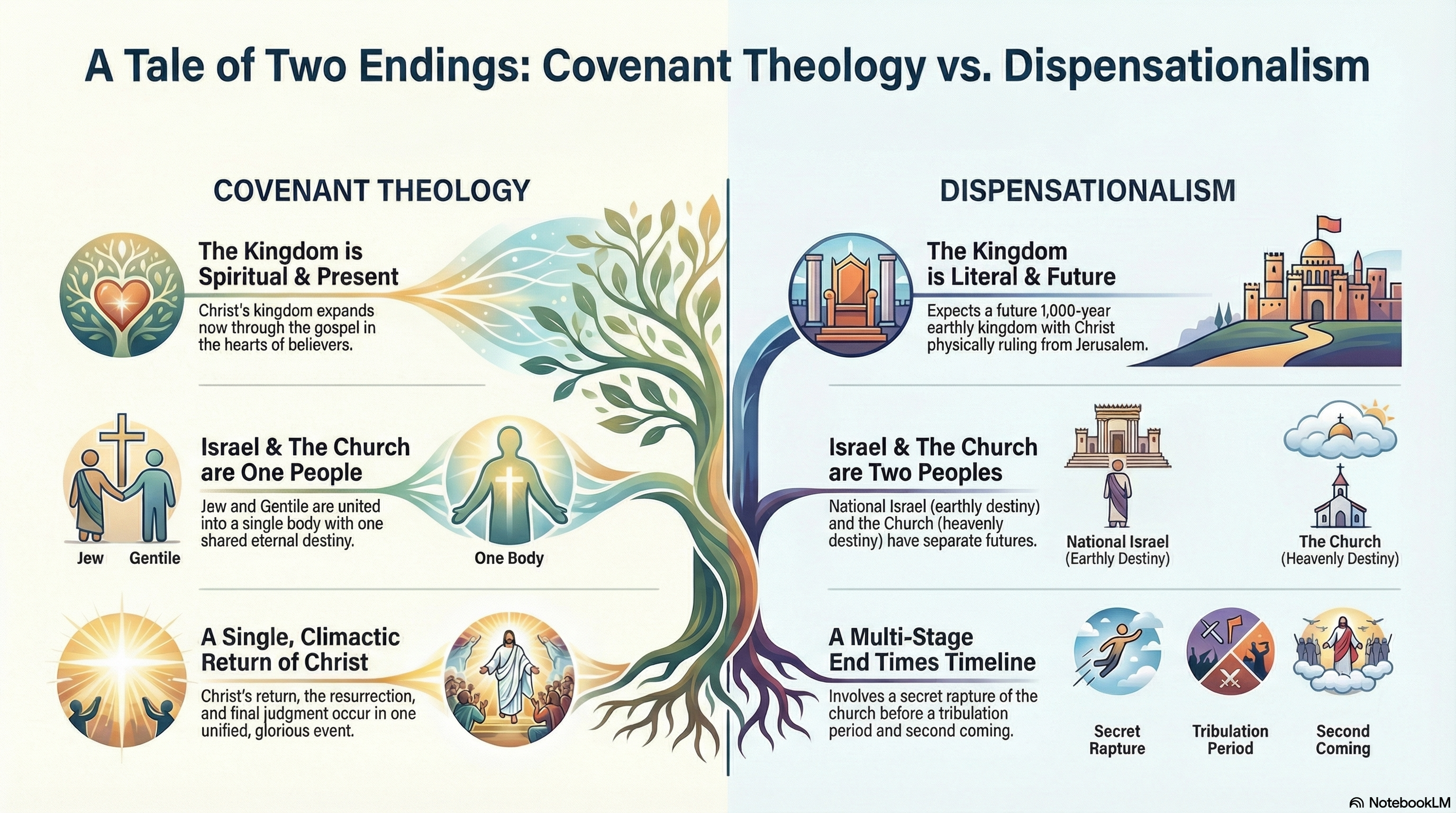
In our previous exploration, we looked at the hermeneutical and theological shifts from Dispensationalism to Covenant Theology (CT). Now, let's focus specifically on how Covenant Theology envisions the end times, offering clarity on its distinct interpretation of Scripture—and why it does so.
---
## 1. Interpreting the Kingdom: Spiritual Fulfillment
**Dispensationalism** expects a literal earthly kingdom centered on ethnic Israel with Jesus physically reigning in Jerusalem. This vision includes a rebuilt temple, animal sacrifices, and geopolitical restoration.
**Covenant Theology**, by contrast, sees Christ’s kingdom as inaugurated spiritually through His life, death, resurrection, and ascension. **“Who hath delivered us from the power of darkness, and hath translated us into the kingdom of his dear Son:”** (Colossians 1:13, KJV). Thus, CT views Old Testament kingdom prophecies as spiritually fulfilled in the present Church Age and consummated fully at Christ’s return.
**Dispensational Objection:** "Jesus promised a literal kingdom on earth."
**CT Response:** Jesus himself said, **“My kingdom is not of this world… but now is my kingdom not from hence.”** (John 18:36, KJV). His rule expands spiritually through the gospel, not through geopolitical power. **“The kingdom of God cometh not with observation… for, behold, the kingdom of God is within you.”** (Luke 17:20–21, KJV). Thus, the kingdom is both present spiritually and future eternally.
---
## 2. The Millennium: Symbolic Thousand Years (Amillennial)
Dispensationalists expect a literal 1,000-year reign of Christ (premillennialism), interpreting Revelation 20:1–6 literally and sequentially.
Covenant Theology, especially its amillennial form, understands the millennium as symbolic of the current gospel age—**Christ reigns now; the souls of departed saints reign with Him in heaven**, while the church on earth advances His kingdom through Word and Spirit. Scripture says, **“And I saw thrones, and they sat upon them… and I saw the souls of them that were beheaded for the witness of Jesus… and they lived and reigned with Christ a thousand years.”** (Revelation 20:4, KJV). The number “thousand” signifies fullness and completeness in apocalyptic literature: **“For every beast of the forest is mine, and the cattle upon a thousand hills.”** (Psalm 50:10, KJV); **“One day is with the Lord as a thousand years, and a thousand years as one day.”** (2 Peter 3:8, KJV).
**Dispensational Objection:** "A thousand years must be literal, as Revelation explicitly states."
**CT Response:** Revelation is symbolic literature; the Spirit’s intent is theological, not merely chronological. Christ’s reign is real now and climactic at His return, encompassing the entire interadvent age.
---
## 3. The Church and Israel: Unified Destiny
Dispensationalism sees distinct eschatological futures for Israel (national restoration) and the Church (heavenly destiny).
Covenant Theology asserts that Christ unites Jew and Gentile into one covenant people, with a singular destiny in the new heavens and new earth. **“For he is our peace, who hath made both one, and hath broken down the middle wall of partition between us… to make in himself of twain one new man.”** (Ephesians 2:14–15, KJV). Romans 11 depicts a future Jewish conversion as part of this one olive tree: **“And they also, if they abide not still in unbelief, shall be grafted in… For if thou wert cut out of the olive tree which is wild by nature… how much more shall these… be grafted into their own olive tree?”** (Romans 11:23–24, KJV).
**Dispensational Objection:** "Romans 11 speaks clearly of a unique future for Israel."
**CT Response:** Romans 11 indeed anticipates the future salvation of many Jews, but **as grafted into the one olive tree**, meaning their future is inseparably bound to the unified Church's destiny, not separate from it.
---
## 4. Eschatological Simplicity: One Return, One Judgment
Dispensationalism typically outlines multiple stages in Christ’s return: a secret rapture, tribulation period, second coming, millennium, and final judgment.
Covenant Theology sees Scripture teaching a simpler and more consistent narrative: Christ’s single, visible return, immediate resurrection, judgment, and the inauguration of the eternal state. **“For the Lord himself shall descend from heaven with a shout… and the dead in Christ shall rise first: Then we which are alive and remain shall be caught up together with them in the clouds, to meet the Lord in the air: and so shall we ever be with the Lord.”** (1 Thessalonians 4:16–17, KJV). **“Marvel not at this: for the hour is coming, in the which all that are in the graves shall hear his voice, And shall come forth…”** (John 5:28–29, KJV). **“When the Son of man shall come in his glory… before him shall be gathered all nations.”** (Matthew 25:31–32, KJV; see also 25:46).
**Dispensational Objection:** "1 Thessalonians 4:16–17 implies a distinct rapture event."
**CT Response:** Paul’s imagery depicts a single, glorious, visible return where believers meet Christ as a welcoming procession—common imagery in ancient cultures for welcoming a returning king—followed immediately by judgment and eternal life.
---
## 5. Prophecy Fulfilled in Christ: Typology, Not Literalism
Dispensationalism holds to literal fulfillments of Old Testament prophecies such as temple reconstruction, animal sacrifices, and land restoration.
Covenant Theology embraces a typological fulfillment: **Christ himself is the ultimate temple, sacrifice, and fulfillment of land promises.** Jesus said, **“Destroy this temple, and in three days I will raise it up… But he spake of the temple of his body.”** (John 2:19, 21, KJV). The epistle to the Hebrews is explicit: **“For by one offering he hath perfected for ever them that are sanctified.”** (Hebrews 10:14, KJV); **“Now where remission of these is, there is no more offering for sin.”** (Hebrews 10:18, KJV). At the consummation, **“I saw no temple therein: for the Lord God Almighty and the Lamb are the temple of it.”** (Revelation 21:22, KJV).
**Dispensational Objection:** "Literal details in prophecy demand literal fulfillment."
**CT Response:** The New Testament itself interprets Old Testament promises Christologically and typologically. This Christ-centered hermeneutic honors Scripture’s own canonical logic: in Him, the shadows find their substance; in the new creation, the types give way to the reality.
---
## Conclusion: Why Covenant Theology’s Vision Matters
Covenant Theology offers a vision of the end times that is Christ-centered, unified, and biblically cohesive. It aligns naturally with the entirety of Scripture, affirming the sufficiency of Christ’s work and uniting all of God’s people in a glorious eternal destiny. **“He which testifieth these things saith, Surely I come quickly. Amen. Even so, come, Lord Jesus.”** (Revelation 22:20, KJV).