# Predestination, “All,” and a Definite Gospel
*By Adam Malin*
*Date: August 25, 2025*
[Audio Overview](https://notebooklm.google.com/notebook/35de5870-dd68-40e7-af13-9c23ce89c644?artifactId=f0dadf97-6502-4cb4-8428-09686620efc8)
[Video Overview](https://youtu.be/ERgg024_w5w)
## 1) Why this matters
Scripture addresses predestination, the sense of “all/world,” and the right use of core theological terms with clarity sufficient for faith and obedience. The apostolic hermeneutic requires Scripture to interpret Scripture, so the church tests every claim by the Word itself (Acts 17:11; 2 Timothy 3:16–17). Thus the following definitions are stated in expository form, locating their sense within the one covenant of grace administered across redemptive history in Christ.
> “All scripture is given by inspiration of God, and is profitable for doctrine, for reproof, for correction, for instruction in righteousness.” (2 Timothy 3:16, KJV)
This approach accords with the confessional rule that the “infallible rule of interpretation of Scripture is the Scripture itself.” 
---
## 2) Definitions that hold together biblically
### Atonement
**Doctrinal thesis:** Scripture teaches that Christ, as Mediator of the covenant of grace, reconciles sinners to God by bearing their sins and removing wrath on their behalf; His cross achieves, not merely makes possible, the salvation of those given to Him.
**Textual witnesses (KJV):**
“For Christ also hath once suffered for sins, the just for the unjust, that he might bring us to God.” (1 Peter 3:18)
“By whom we have now received the atonement.” (Romans 5:11)
**Expository note:** The apostolic writers set forth the cross as propitiatory and effectual: God publicly displays Christ to declare His righteousness and to justify the believer (Romans 3:24–26). Hebrews emphasizes that the single offering perfects the sanctified, evidencing a completed, covenant-making work rather than a provisional attempt (Hebrews 10:14; cf. Hebrews 10:10–18). Thus, by covenantal design, Christ’s sacrifice actually secures reconciliation and peace for His people.
> “For by one offering he hath perfected for ever them that are sanctified.” (Hebrews 10:14, KJV)
### Depravity (Total Inability)
**Doctrinal thesis:** Scripture teaches that mankind, fallen in Adam, is morally corrupt and spiritually unable to come to Christ apart from sovereign grace; effectual calling is therefore necessary for faith.
**Textual witnesses (KJV):**
“There is none righteous, no, not one… there is none that doeth good, no, not one.” (Romans 3:10–12)
“And you hath he quickened, who were dead in trespasses and sins.” (Ephesians 2:1)
“No man can come to me, except the Father which hath sent me draw him.” (John 6:44)
**Expository note:** The apostolic testimony identifies universal guilt and spiritual death as the estate of nature (Romans 3:9–19; Ephesians 2:1–3). Inability (“no man can come”) highlights the necessity of the Father’s drawing and the Spirit’s life-giving work, consistent with the doctrines of unconditional election, effectual calling, and the perseverance of the saints within the covenant of grace (John 6:37–45; Romans 8:28–30).
### Saint
**Definition:** Scripture designates a saint as a believer set apart in Christ by God’s call and sanctifying grace.
**KJV:** “To them that are sanctified in Christ Jesus, called to be saints.” (1 Corinthians 1:2)
---
### Regeneration
**Definition (tightened):** Scripture teaches that regeneration is the **new birth** whereby God makes a sinner alive, from which spring faith and repentance.
**KJV:** “Except a man be born again, he cannot see the kingdom of God.” (John 3:3)
**KJV:** “Not by works of righteousness which we have done, but according to his mercy he saved us, by the washing of regeneration, and renewing of the Holy Ghost.” (Titus 3:5)
**KJV:** “Which were born, not of blood, nor of the will of the flesh, nor of the will of man, but of God.” (John 1:13)
**Nuance:** Regeneration is not the whole of salvation; it is the root by which one first lives unto Christ and from which faith and repentance arise (Acts 16:14; Ezekiel 36:26–27; John 3:5–8).
---
## 3) The system that coheres: TULIP in brief
1. **Total Depravity / Inability** — Scripture declares the natural man unable to receive the things of the Spirit and hostile to God (1 Corinthians 2:14; Romans 8:7–8; Ephesians 2:1–5).
2. **Unconditional Election** — God chose a people in Christ before the foundation of the world, not based on foreseen works (Ephesians 1:4–5; Romans 9:11–16).
3. **Definite (Particular) Atonement** — The Son lays down His life for the sheep, saving **His people** and loving the **church** particularly (John 10:11, 15; Matthew 1:21; Ephesians 5:25).
4. **Effectual Calling (Irresistible Grace)** — All whom the Father gives to the Son **shall come**; those predestinated are called and brought to faith (John 6:37; Romans 8:30; Acts 16:14).
5. **Perseverance of the Saints** — Christ preserves His sheep so that **they shall never perish**; believers are **kept by the power of God** (John 10:27–29; 1 Peter 1:5).
**Why it’s internally consistent:** Inability necessitates sovereign grace; election accounts for a people who certainly come; the atonement and intercession stand together for the same persons (Romans 8:33–34); those effectually called are glorified, and therefore kept to the end (Romans 8:30).
---
## 4) Predestination and the “for all/world” verses — no contradiction
### What predestination secures
Scripture teaches that predestination secures adoption in Christ and carries the elect through an unbreakable chain from calling to justification to glory; the Son loses none of those given by the Father.
**KJV:** “Having predestinated us unto the adoption of children by Jesus Christ to himself.” (Ephesians 1:5)
**KJV:** “Whom he did predestinate, them he also called… justified… glorified.” (Romans 8:30)
**KJV:** “All that the Father giveth me shall come to me… of all which he hath given me I should lose nothing.” (John 6:37, 39)
**Matthew 22:1–14—Call and Choice Together**
The parable concludes, “For many are called, but few are chosen” (Matthew 22:14). The outwardly invited appear, yet admission requires the wedding garment (Matthew 22:11–12). By the apostolic pattern, this clothing is God-given righteousness: “he hath clothed me with the garments of salvation” (Isaiah 61:10; cf. Zechariah 3:3–5). Election is not suspended on man; rather, those whom God chooses He also clothes, and thus they are received (compare John 6:37, 39).
### How Scripture uses “all” and “world”
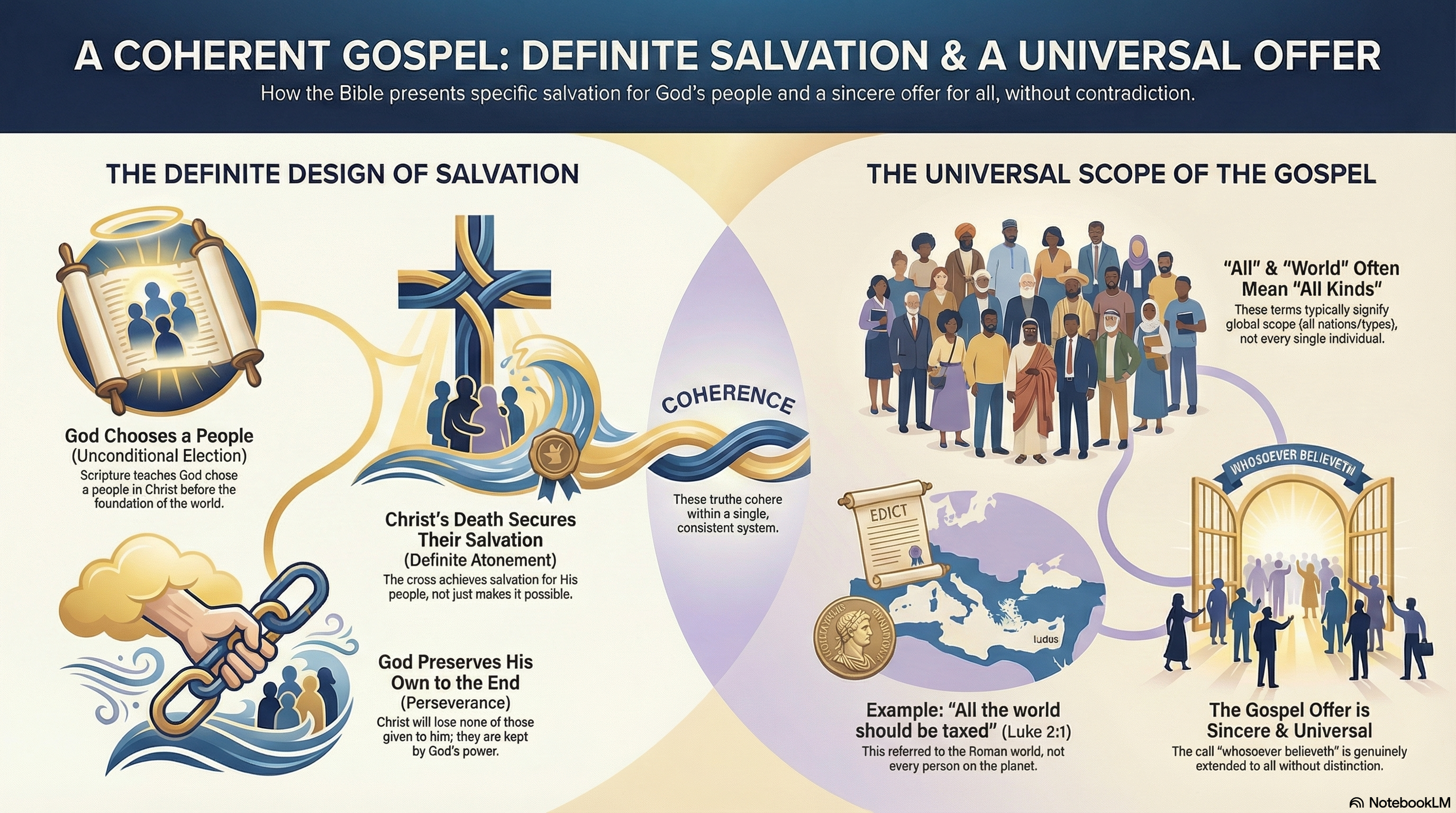
Scripture frequently employs these terms to signal **breadth** (all kinds, all nations) rather than a numerical **every individual** without exception.
**KJV:** “There went out a decree from Caesar Augustus, that **all the world** should be taxed.” (Luke 2:1) — the Roman world, not every human.
**KJV:** “For God so loved the world… that **whosoever believeth** in him should not perish.” (John 3:16) — a sincere, universal offer; and God effectually brings His elect to faith (Acts 13:48).
### Key texts in context
* **1 Timothy 2:1–6** — Prayers are urged “for **all men; For kings**” (1 Timothy 2:1–2). God “will have **all men** to be saved,” and Christ “gave himself a **ransom for all**” (1 Timothy 2:4, 6). The scope is **all kinds** (even rulers), not one class only; Paul’s Gentile apostleship (1 Timothy 2:7) underscores this breadth.
* **2 Peter 3:9** — God is “longsuffering **to us-ward**, not willing that **any** should perish, but that **all** should come to repentance.” The “us-ward” frames the referent: God’s patience ensures **none of His people** perish before being brought to repentance.
* **1 John 2:2** — Christ is the **propitiation** “for our sins: and not for ours only, but also for the **sins of the whole world**.” Since propitiation removes wrath, John’s emphasis is scope **beyond our circle**—not Jews only, but throughout the world (cf. John 11:51–52).
* **Hebrews 2:9–17** — He “should taste death for **every man**” (Hebrews 2:9) within a context of God “bringing **many sons** unto glory” (Hebrews 2:10), the “**children which God hath given**” (Hebrews 2:13), and His taking hold of “the **seed of Abraham**” (Hebrews 2:16). The flow reads naturally as **every one** of those sons/children.
* **2 Corinthians 5:14–15, 17** — “If **one died for all**, then were **all dead**… that they which **live** should… live unto him… Therefore if any man be in Christ, he is a **new creature**.” Union-with-Christ logic governs the scope: those for whom He died die and rise with Him unto new creation.
* **John 12:32** — “And I, if I be lifted up… will draw **all men** unto me.” With Greeks present (John 12:20–23), “all men” signals **all kinds** (Jews and Gentiles), matching the worldwide commission (cf. Luke 24:47).
* **Romans 11:32** — “God hath concluded them **all** in unbelief, that he might have mercy upon **all**.” Paul contrasts Jews and Gentiles (Romans 11:11–12, 25); both “alls” denote the two groups, fitting his Jew–Gentile mercy theme.
### Sincere offer; definite design
**KJV:** “Him that cometh to me I will in no wise cast out.” (John 6:37)
**KJV:** “The good shepherd giveth his life for the **sheep**.” (John 10:11)
**KJV:** “He shall save **his people** from their sins.” (Matthew 1:21)
**KJV:** “Who shall lay any thing to the charge of **God’s elect**? It is God that justifieth.” (Romans 8:33)
**Summary:** Scripture joins a sincere, universal gospel offer—**whosoever believeth**—with a definite design by which the cross effectually redeems those the Father gave to the Son (John 17:2, 9; John 10:26–28). These truths cohere without contradiction.
---
## 5) Clarifying difficult or debated nuances
### A) “God loves everyone the same” vs. biblical distinctions
Scripture distinguishes God’s **general goodness** to all from His **saving love** fixed upon His people.
**KJV:** “He maketh his sun to rise on the evil and on the good.” (Matthew 5:45)
**KJV:** “Thou hatest all workers of iniquity.” (Psalm 5:5)
**KJV:** “Jacob have I loved, but Esau have I hated.” (Romans 9:13; cf. Malachi 1:2–3)
**KJV:** “Christ also loved the **church**, and gave himself **for it**.” (Ephesians 5:25)
**KJV:** “I pray for them: I pray **not for the world**, but for them which thou hast given me.” (John 17:9)
**Takeaway:** God is good to all; yet He sets **saving, covenant love** on His elect in Christ.
### B) “Hate = love less” in Romans 9?
While “hate” can be comparative in some texts (Luke 14:26), Romans 9:11–23 employs election and reprobation categories to uphold God’s purpose “not of works, but of him that calleth” (Romans 9:11), including hardening (Romans 9:18) and the potter’s right (Romans 9:20–23). This is covenant-judicial language, not mere preference.
### C) Double predestination, rightly nuanced
Scripture teaches God’s **active election** unto life and His **passing by** others (preterition), ordaining them to wrath **for their sin**, while affirming that God is **not** the author of sin.
**KJV:** “Therefore hath he mercy on whom he will have mercy, and whom he will he hardeneth.” (Romans 9:18)
**KJV:** “Who were before of old **ordained to this condemnation**.” (Jude 4)
**KJV:** “Whereunto also they **were appointed**.” (1 Peter 2:8)
**KJV:** “God cannot be tempted with evil, neither tempteth he any man.” (James 1:13)
### D) Predestination vs. providence
**Predestination** concerns God’s decree of **salvation in Christ** (Ephesians 1:4–5). **Providence** is God’s wise governance of **all things** (Ephesians 1:11; Psalm 103:19; Daniel 4:35). The categories are distinct yet harmonious.
### E) Temporary faith and perseverance
Some exhibit **temporary** belief outwardly yet lack root; true believers persevere.
**KJV:** “Which for a while believe, and in time of temptation fall away.” (Luke 8:13; cf. Matthew 13:20–21)
**KJV:** “They went out from us, but they were not of us.” (1 John 2:19)
**KJV:** “My sheep… **shall never perish**.” (John 10:27–29)
**KJV:** “He that shall **endure unto the end**, the same shall be saved.” (Matthew 24:13)
### F) “All men” in other texts
* **1 Timothy 4:10** — “The Saviour of **all men**, specially of those that believe.” God is universal Preserver (common grace), with **saving** favor fixed on believers.
* **John 1:29** — “Behold the Lamb of God, which taketh away the sin of the **world**.” As with 1 John 2:2 and John 11:51–52, the emphasis is **worldwide scope**, not a headcount of every individual without exception.
* **Romans 5:18–19** — Two humanities: **in Adam** and **in Christ**. The “all” justified are **all who are in Christ**, as the condemned are all in Adam; representative headship governs Paul’s logic.
> **2 Peter 2:1** — False teachers “deny the Lord that bought them.” Scripture frequently uses “bought” covenantally for God’s claim over a visible people (e.g., Israel): “Is not he thy Father that hath bought thee?” (Deuteronomy 32:6). Peter describes men under the Lord’s outward ownership within the church’s sphere, not a saving propitiation actually applied to them (contrast 1 John 2:2; Romans 8:33–34).
---
## 6) Putting it together in practice
1. **Proclaim Christ to all without distinction:** “Whosoever shall call upon the name of the Lord shall be saved.” (Romans 10:13)
2. **Rest upon God’s immutable purpose:** “The foundation of God standeth sure, having this seal, The Lord knoweth them that are his.” (2 Timothy 2:19)
3. **Employ biblical terms reverently and in context:** Read “all/world” texts according to their scope, and confess both the **sincere offer** and the **definite redemption** (John 3:16; John 10:11; Romans 8:33–34).
---
## 7) A final one-paragraph summary
God, in sovereign grace, **chose** a people in Christ (Ephesians 1:4–5) and **effectually calls** them (Romans 8:30); the Son laid down His life **for the sheep** (John 10:11) and will **lose none** given to Him (John 6:39). The language of **“all/world”** magnifies the gospel’s **global scope** and the inclusion of **all kinds** of sinners (Luke 2:1; 1 Timothy 2:1–6; 1 John 2:2), while texts that speak of the cross’s **effect** restrict its saving application to **His people** (Matthew 1:21; Ephesians 5:25). Thus the offer stands truly **to all** (John 3:16), and the redemption stands truly **effective** for the elect (Romans 8:33–34). This coherence preserves the glory of God and secures the believer’s assurance (John 10:27–29).
---
### Suggested passages to read in one sitting
* John 6; John 10; Romans 8–9; Ephesians 1–2; Hebrews 2.
* Observe the unity of **design (definite redemption)** and **scope (global invitation)**.
> “Him that cometh to me I will in no wise cast out.” (John 6:37)
*The gospel commanded to be proclaimed to all is the very gospel by which the Shepherd certainly gathers His sheep.*