# Reading the KJV with Confidence
*By Adam Malin*
*Date: August 23, 2025*
[Audio Overview](https://notebooklm.google.com/notebook/00e2850b-66ed-425d-8be6-ee9c9e1e7a71?artifactId=09b3e978-7d53-4dfa-8141-a89131ec594a)
[Video Overview](https://youtu.be/XJpTlRtfhWA)
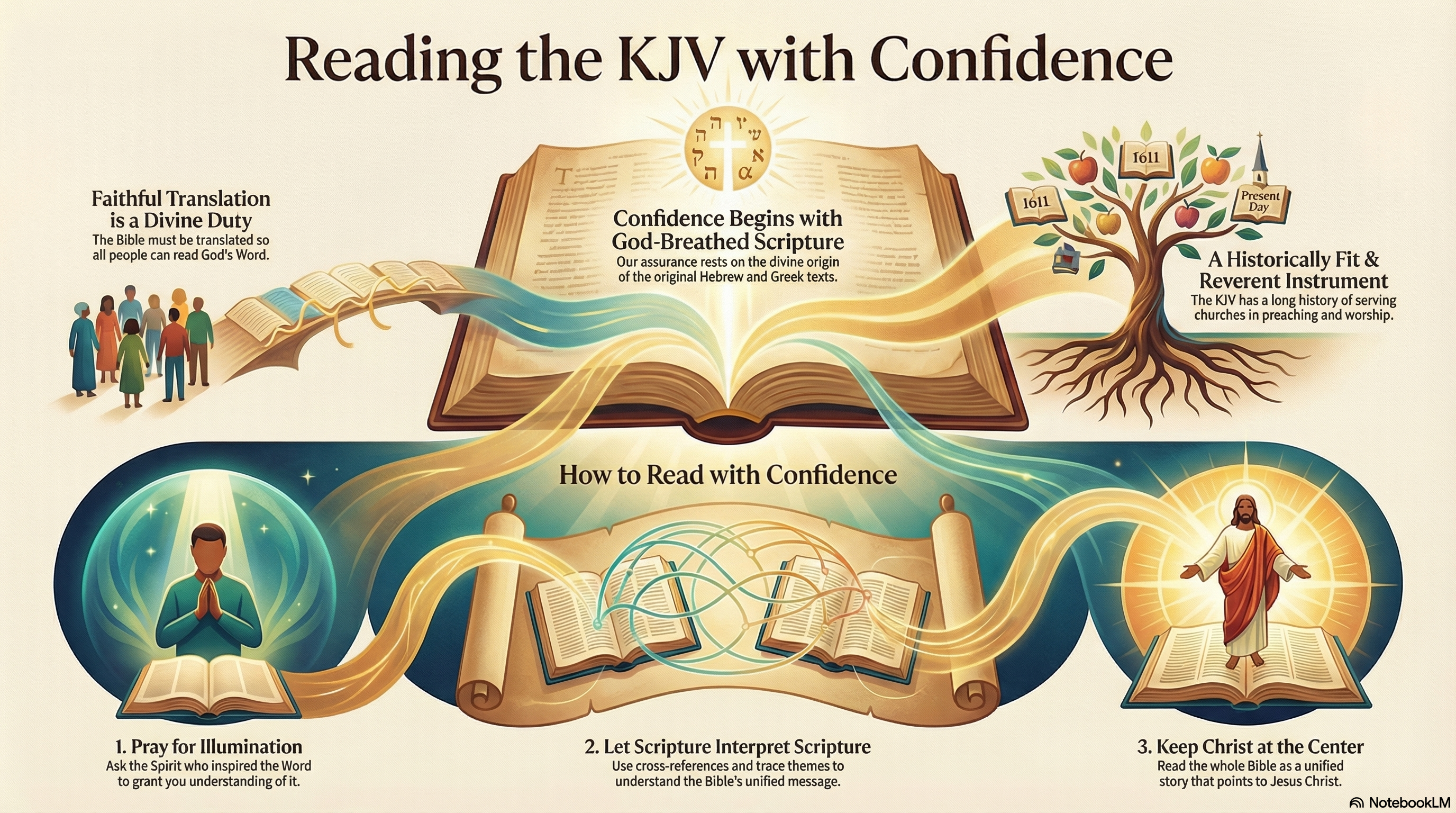
*A covenantal guide showing why English-speaking Christians may read the King James Version with settled assurance under the doctrine of Scripture confessed by the Reformed churches.*
> “All scripture is given by inspiration of God, and is profitable for doctrine, for reproof, for correction, for instruction in righteousness: That the man of God may be perfect, throughly furnished unto all good works.” (2 Timothy 3:16–17, KJV)
---
## 1) Start where Scripture starts: God-breathed words
Scripture declares its own divine origin and truthfulness. The Word is truth (John 17:17); the Lord’s words are pure, as silver tried and purified (Psalm 12:6–7); every word of God is pure, and none may be added (Proverbs 30:5–6). Therefore the church rests its confidence not on human testimony, but on what Scripture is: God-breathed and self-authenticating (2 Timothy 3:16–17).
The Westminster Confession summarizes this self-witness: the believer’s “full persuasion and assurance of the infallible truth and divine authority” of Scripture is from the inward work of the Holy Spirit bearing witness by and with the Word in the heart. This same chapter teaches the sufficiency of Scripture for “all things necessary for His own glory, man’s salvation, faith and life,” whether expressly stated or by good and necessary consequence, so that nothing is to be added by new revelation or human tradition. While not all passages are alike plain, those things necessary to be known, believed, and observed for salvation are clearly set forth; even the unlearned, by ordinary means, may attain sufficient understanding (Psalm 119:105, 130; 2 Peter 3:16).  
Consequently, confidence in reading an English Bible flows from Scripture’s own nature, received by the Spirit, not from the prestige of a translation. The apostolic hermeneutic then governs how it is read: “to the law and to the testimony” (Isaiah 8:20), with Scripture interpreting Scripture, since the infallible rule of interpretation is Scripture itself. 
---
## 2) Why the KJV?
**Confessional grounding: originals and translation.** Westminster I.VIII teaches that the Old Testament in Hebrew and the New Testament in Greek were immediately inspired and, by God’s singular care and providence, “kept pure in all ages,” and are therefore authentical; the Church is finally to appeal to them in all controversies. Yet because these tongues are not known to all, God’s people—who have right and interest in the Scriptures, and are commanded to read and search them—require faithful translations “into the vulgar language of every nation,” that the Word may dwell richly in all (cf. John 5:39; Colossians 3:16; 1 Corinthians 14). Thus translation is not concession but duty; public intelligibility is an apostolic requirement (Nehemiah 8:8; 1 Corinthians 14:6, 9–12).
**Historical fitness for worship and catechesis.** Produced (A.D. 1611) by learned pastor-scholars with direct concern for the church’s pulpit and pew, the KJV was deliberately shaped for accuracy and public reading, drawing on the received Hebrew and Greek text and the prior labors of the English Reformation. Its idiom serves proclamation, memory, and catechesis, helping congregations “let the word of Christ dwell in \[them] richly” (Colossians 3:16), in keeping with the Confession’s aim that Scripture be heard plainly by all. 
**Textual humility and the church’s use.** Because authority resides finally in the God-breathed originals, the church receives translations ministerially, not magisterially. Confidence is grounded in the Spirit’s testimony to the Word, not in any one vernacular form; yet the KJV has long proved a reverent, serviceable instrument for English-speaking churches in preaching, prayer, and family worship. 
**Apostolic reading aided.** The KJV’s close alignment to biblical syntax and intertextual cadences often helps readers trace the canonical unity by which promise gives way to fulfillment in Christ (Luke 24:27; John 5:39). By this apostolic method, the church reads the whole counsel of God and refuses additions from new revelations or human tradition. 
> “So they read in the book in the law of God distinctly, and gave the sense, and caused them to understand the reading.” (Nehemiah 8:8, KJV)
**Conclusion.** Scripture’s inspiration, sufficiency, perspicuity, and self-interpretation—received by the Spirit and confessed by the Reformed churches—establish the ground of confidence. Within this framework, the King James Version stands as a time-tested English witness enabling God’s people to hear, believe, and obey the voice of Christ in the Scriptures to the glory of God. (Romans 15:4; Matthew 4:4; Isaiah 8:20). 
---
## 3) What is—and is not—meant by confidence
**Affirmation.** Confidence means that the King James Version faithfully renders the authentic Scriptures God immediately inspired in Hebrew and Greek; therefore it may be safely used for doctrine and life (2 Timothy 3:16–17; Psalm 19:7–11). Scripture teaches its own sufficiency and profit for every good work, so that an accurate translation is a fit instrument for teaching, reproof, correction, and instruction in righteousness.
**Denial.** Confidence does not ascribe a new inspiration to any English edition, nor confine God’s speech to one historical dialect. Scripture declares the enduring authority of the law and the inviolability of every “jot” and “tittle” (Matthew 5:18), and the prophet testifies that the Word of our God stands forever (Isaiah 40:8). Translations possess authority **derivatively**, in so far as they convey God’s words faithfully; this guards the church from resting confidence upon numerology, mere tradition, or the decisions of any single editor or printer. By the apostolic rule—Scripture interpreting Scripture—the church submits every human product to the touchstone of the God-breathed originals (Isaiah 8:20; Acts 17:11).
---
## 4) A covenantal lens that strengthens assurance
The covenantal storyline—promise and fulfillment—grounds assurance that God both **gave** and **preserved** His Word. The Lord Jesus identifies the threefold Hebrew canon—“the law of Moses, and in the prophets, and in the psalms”—as that which speaks of Him (Luke 24:44). The apostle states that Israel was entrusted with “the oracles of God” (Romans 3:2). Hebrews declares that the God who formerly spoke by the prophets “hath in these last days spoken unto us by his Son” (Hebrews 1:1–2). By this apostolic hermeneutic, the unity of redemptive history in the one covenant of grace is manifest: the types and shadows give way to the substance in Christ (Colossians 2:17; Hebrews 10:1).
Therefore, preservation is confessed not as a bare abstraction but as providence in service of Christ’s mediatorial kingdom. The Scripture “cannot be broken” (John 10:35); not one covenant promise fails, nor does the written testimony that heralds the Mediator fail. Within this stream of providence, the King James Version stands as a faithful English witness to the Christ-centered voice of Moses, the Prophets, the Psalms, and the Apostles.
---
## 5) Concerning the “number seven” and the KJV
Scripture frequently employs **seven** as a symbol of completeness (e.g., Psalm 12:6; Revelation 1:4). Observers may note striking “sevens” in the KJV’s history or lineage and rightly acknowledge God’s providence over times and seasons. Yet the church must not advance numeric patterns into doctrine. The apostolic charge is, “Prove all things; hold fast that which is good” (1 Thessalonians 5:21), and the covenantal rule warns against resting faith upon secret things rather than revealed truth (Deuteronomy 29:29).
Confidence in the KJV rests on firmer ground: the promises and perfections God assigns to His Word—its purity, preservation, and power (Psalm 12:6–7; Isaiah 40:8; Matthew 5:18)—received by the church through faithful translation and confirmed by the Spirit as Scripture interprets Scripture.
---
## 6) How to read the KJV with confidence today (practical helps)
1. **Seek illumination in prayer.** Wisdom is asked of God, who giveth liberally (James 1:5). The Spirit who gave the Word grants understanding of the Word (Psalm 119:18; 1 Corinthians 2:12–13).
2. **Keep the covenant storyline in view.** Christ is the center; the law, the prophets, and the psalms speak of Him and are fulfilled in Him (Luke 24:44; John 5:39). Read types and shadows unto their substance in Christ (Colossians 2:17; Hebrews 10:1).
3. **Use helps without supplanting Scripture.** Marginal notes, concordances, and a trustworthy dictionary serve clarity, but the text rules all. Scripture was read “distinctly,” the sense was given, and understanding followed (Nehemiah 8:8; Acts 8:30–35; Proverbs 4:7).
4. **Let Scripture interpret Scripture.** Follow cross-references and trace themes across the covenants; contend for the once-delivered faith by canonical comparison (Jude 3; Hebrews 8–10; Isaiah 8:20).
5. **Attend to public and private reading.** Give attendance to reading in the congregation and to reading at home; both receive promise (1 Timothy 4:13; Colossians 4:16; Revelation 1:3).
6. **Hide the Word in the heart.** Memorization and meditation fortify holiness and comfort (Psalm 119:11, 15–16; Joshua 1:8).
7. **Walk in the light received and seek further light.** Be doers of the Word; present light guides the next step while further clarity is prayerfully pursued (Psalm 119:105, 130; James 1:22).
> “The law of the LORD is perfect, converting the soul: the testimony of the LORD is sure, making wise the simple.” (Psalm 19:7)
---
## 7) Quick answers to common objections
**“Isn’t the language too old?”** Some terms are archaic, yet the structure is clear, and the second-person forms (thee/thy vs. ye/you) often sharpen precision. The entrance of God’s words gives light to the simple (Psalm 119:130). With ordinary helps and patient use, readers adjust and profit (Nehemiah 8:8; Proverbs 4:7).
**“What about other books some Bibles include?”** The Lord identified the Hebrew canon as law, prophets, and psalms (Luke 24:44). Israel was entrusted with those oracles (Romans 3:2). The church receives the sixty-six books as God-breathed; other writings may be historically useful, but they do not bind faith or life (2 Timothy 3:16–17; Proverbs 30:5–6).
**“Do textual debates destroy confidence?”** No. Scripture asserts its purity, permanence, and unbreakable authority (Psalm 12:6–7; Isaiah 40:8; John 10:35; Matthew 5:18). Confidence rests on what God says of His Word; the King James Version, being a faithful translation, is a fit instrument for hearing and obeying that Word (James 1:22; Revelation 1:3).
---
## 8) A final encouragement
“Prove all things; hold fast that which is good” (1 Thessalonians 5:21). Let the saints read the KJV with gratitude and courage, using its clear, reverent English to know Christ, worship God, resist sin, and comfort the afflicted. Take “the sword of the Spirit, which is the word of God” (Ephesians 6:17). When a hard passage arises, seek wisdom of God, who giveth liberally and upbraideth not (James 1:5).
> “Being born again, not of corruptible seed, but of incorruptible, by the word of God, which liveth and abideth for ever.” (1 Peter 1:23)
---
### Suggested next steps
* Begin a month-long plan through **Genesis–Deuteronomy (highlights), Psalms, Isaiah (highlights), John, Romans, Hebrews, and James**, reading with Christ-centered, covenantal expectation (Luke 24:27, 44).
* Keep a brief list of words to look up and a running chain of cross-references that link law, prophets, psalms, Gospel, and epistle (Nehemiah 8:8; Acts 17:11).
* Each week share one verse with another believer and discuss how it bears witness to Christ and summons obedience (Colossians 3:16; John 5:39).