# Genesis “Days” & Deep Time in a Reformed Covenant Reading
[Audio Overview](https://notebooklm.google.com/notebook/c36c68e2-8e03-4b52-b2da-d42e67f42655?artifactId=78acaf25-8939-4f58-a919-fa5cc0dcb979)
[Video Overview](https://youtu.be/7Xn5e2vi9a0)
## Thesis
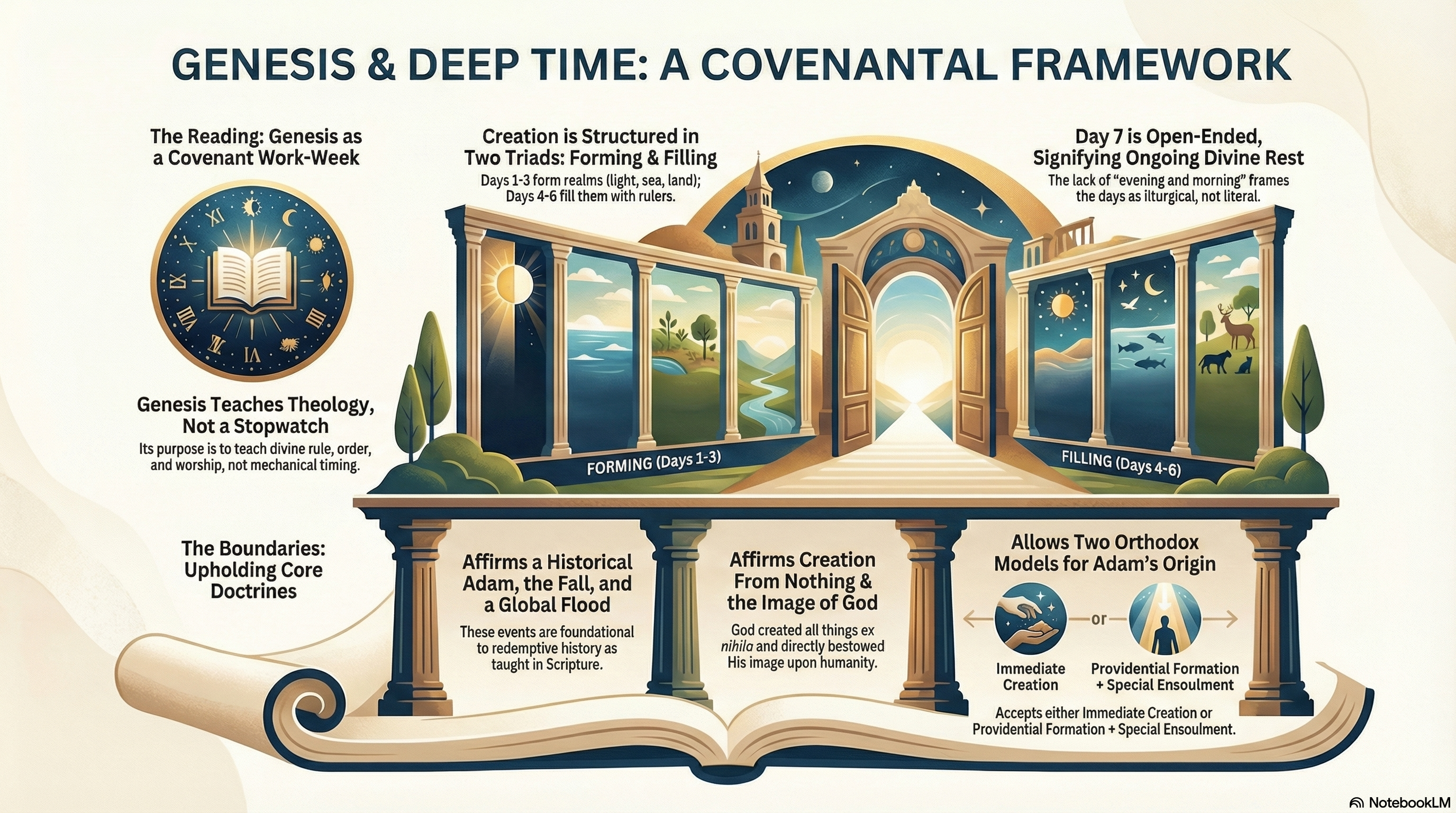
I affirm the **inerrancy and sufficiency of Scripture**. **God created all things *ex nihilo***—“**In the beginning God created the heaven and the earth**” (Gen 1:1); “**Through faith we understand that the worlds were framed by the word of God**” (Heb 11:3). Read on its own terms, Genesis 1 is a **covenantal work‑week presentation**—real divine acts arranged as **six divine workdays** culminating in **Sabbath enthronement** (Gen 2:2–3; Exod 20:8–11; 31:13–17; Heb 4). The text’s purpose is to **teach rule, order, and worship**, not to provide a mechanical stopwatch. Therefore, receiving an **ancient cosmos** as descriptive timing for God’s handiwork does **not** threaten biblical authority (Ps 19:1). Within these bounds we confess a **historical Adam and Eve**, the **direct conferral of the image of God** and **breath of life** (Gen 2:7), **Adam’s federal headship** and a **real Fall** (Rom 5; 1 Cor 15), and a **global Flood** (Gen 6–9; 2 Pet 3:6).
---
## 1) Method: Exegesis before Synthesis
We begin with **exegesis**—grammar, structure, and canonical context—**before** asking how Scripture relates to observations of creation.
* **Two triads (forming → filling).** *Days 1–3* form realms (light/dark; sky/sea; land/vegetation). *Days 4–6* fill them with rulers (luminaries; birds/fish; animals/humans). The symmetry teaches **kingdom order** and **temple‑cosmos** themes.
* **Open‑ended Day 7.** Unlike Days 1–6, Day 7 lacks “evening and morning.” Hebrews treats God’s rest as **ongoing** (Heb 4:3–10). The cadence functions as **liturgical brackets**, not a time code.
* **Sabbath telos.** Exodus 20 grounds Israel’s six‑and‑one rhythm in **God’s** pattern; Exodus 31 calls the Sabbath a **covenant sign**.
**Guardrails**
* **Science‑off test:** If modern science vanished, would this reading remain? Yes—because it arises from the text’s **own signals**.
* **Confession‑on test:** Historic Reformed confessions say God created **“in the space of six days.”** That clause safeguards **order and sequence**; it does **not** itself define human clock‑length. Our reading honors the **pattern, sequence, and Sabbath** without imposing a metric the text does not specify.
---
## 2) Confessional Boundaries (Reformed Covenant)
* **Creation *ex nihilo*** by the Triune God (Gen 1:1; Heb 11:3).
* **Six “days”** as God’s ordered work pattern, culminating in **Sabbath rest** (Gen 2:2–3; Exod 20:8–11; 31:13–17).
* **Historical Adam and Eve**, the **Fall**, and a real, catastrophic **Flood** (Rom 5:12; 1 Cor 15:22; Gen 6–9; 2 Pet 3:6).
* **Sabbath as covenant sign** and **archetype** of eschatological rest (Ps 95; Heb 3–4).
**Implication:** With these non‑negotiables in place, believers may evaluate descriptive claims about **timing** in God’s world without capitulating on **theology or history**.
---
## 3) What “day” (*yom*) is doing in Genesis 1–2
* **Flexible within the chapter:** In Gen 1:5, *day* means **daylight** and also the **completed work‑period**. Context governs.
* **Summary usage:** “**In the day** that the LORD God made…” (Gen 2:4) summarizes the whole creation span.
* **Idiomatic timing:** “**In the day** that thou eatest…” (Gen 2:17) = **when**, not “within 24 hours.”
* **Luminaries appointed on Day 4** “for **signs**, and for **seasons**, and for **days**, and **years**” (Gen 1:14–18), emphasizing **rule and order**, not retro‑calibrating Days 1–3.
* **Merism as cadence:** “evening and morning” marks bounded phases of God’s work; Day 7’s omission is the canonical cue to **ongoing rest** (Heb 4).
**Conclusion:** Genesis presents **analogical workdays**—God’s archetypal pattern grounding our weekly rhythm—without requiring human‑length solar days.
---
## 4) Providence & Means: God’s Two Ways of Working
God acts **extraordinarily** (miracles) and **ordinarily** (providence). “**The lot is cast into the lap; but the whole disposing thereof is of the LORD**” (Prov 16:33). If He orders lots and kings, He may govern biological processes without ceasing to be **Creator**. “**One day is with the Lord as a thousand years, and a thousand years as one day**” (2 Pet 3:8; cf. Ps 90:4) cautions humility about **divine days**.
---
## 5) Adam, Dust, and the God‑Breathed Image
God **formed man of the dust** and **breathed** life so that man **became a living soul** (Gen 2:7). Humanity alone bears the **imago Dei** (Gen 1:26–27) with a royal‑priestly vocation.
Within historic Reformed bounds, two admissible models preserve these truths:
1. **Immediate/Special Creation:** God specially creates an original pair and directly confers the image.
2. **Providential Formation + Special Appointment/Ensoulment:** God providentially forms the human body over time and, at a real historical moment, **appoints/ensouls** Adam and Eve, conferring the image and installing Adam as **federal head**.
In both, Adam is **historical**, the **Fall** is real, and the imago is **bestowed**, not emergent (1 Cor 15:47).
To clarify this terminology: **"Providential Formation"** suggests God used ordinary, guided natural processes (what science might observe as evolution) to prepare Adam's physical form from "the dust." **"Special Ensoulment"** refers to the subsequent, extraordinary act where God directly imparted the "breath of life" (Genesis 2:7)—the rational soul, the *imago Dei*—and established Adam as the covenantal head of humanity. This model therefore distinguishes the historical Adam from any pre-Adamic hominids, who would have been creatures without the divine image or federal status.
---
## 6) Old‑Earth as Theological Synthesis (Special + General Revelation)
After exegesis, we ask: *What does God’s world say about timing?* Observations of starlight, stellar lifecycles, and galactic structures point to **deep time**. Receiving that timing **does not rewrite Genesis**, because Genesis proclaims **who** created and **why**. Thus:
* No need for **strained fixes** (e.g., light created “in transit”).
* Vast ages can be God’s **ordinary providence** in a “very good” world.
* Scripture retains **normative authority** for theology and history; nature offers **descriptive timing** as God’s handiwork (Ps 19:1).
---
## 7) Common Objections (Brief Replies)
**“Death before the Fall?”** Scripture ties Adam’s sin to **human** death and the ground’s curse (Rom 5; Gen 3). Many orthodox old‑earth readings allow animal predation while insisting **human death and covenant curse** arrive **with Adam**.
**“Does analogical day undermine inerrancy?”** No. Inerrancy binds us to **what the text intends to assert**. If the intent is a **work‑week analogy** that grounds Sabbath, reading it that way is fidelity, not evasion.
**“Isn’t this accommodating science?”** Not if the interpretive move is made **from the text outward**. The analogical/framework reading stands on **literary features**; scientific descriptions then speak to **timing**, not **theology**.
**“What about the Flood?”** Scripture teaches a **global judgment** in Noah’s day and an abiding Noahic covenant (Gen 6–9; 2 Pet 3:6). This confession does not hinge on any one post‑Flood geologic model.
**“Do genealogies fix earth’s age?”** Biblical genealogies often **telescope** to trace covenant lineage, not to yield exhaustive chronologies.
---
## 8) Payoffs
* **Confidence:** Scripture’s authority stands; we need not fear telescopes or microscopes.
* **Worship:** A cosmos proclaiming God’s glory across eons enlarges praise (Ps 19:1).
* **Sabbath & vocation:** God’s six‑and‑one pattern dignifies labor and rest (Exod 20:8–11; 31:13–17).
* **Gospel clarity:** A real Adam and the real Christ remain the backbone of redemptive history (Rom 5; 1 Cor 15).
---
## Appendix A — KJV Passages to Memorize
* **Genesis 1:1** — “In the beginning God created the heaven and the earth.”
* **Genesis 2:7** — “And the LORD God formed man of the dust of the ground, and breathed into his nostrils the breath of life; and man became a living soul.”
* **Psalm 19:1** — “The heavens declare the glory of God; and the firmament sheweth his handywork.”
* **Proverbs 16:33** — “The lot is cast into the lap; but the whole disposing thereof is of the LORD.”
* **Romans 5:12** — “Wherefore, as by one man sin entered into the world, and death by sin…”
* **1 Corinthians 15:47** — “The first man is of the earth, earthy: the second man is the Lord from heaven.”
* **2 Peter 3:6** — “Whereby the world that then was, being overflowed with water, perished.”
---
## Appendix B — Two‑Models Language (for mixed audiences)
Within the **Reformed Covenant** boundaries above: creation *ex nihilo* (Gen 1:1; Heb 11:3); a real Adam and Eve in God’s image (Gen 1:26–27); God’s special act of breathing life (Gen 2:7); a Covenant of Works and the Fall with death through Adam (Rom 5); salvation in the last Adam, Jesus Christ (1 Cor 15). On the **mechanism** of human biological origins, Scripture binds us to a **historical Adam under God’s special action**; Christians may charitably differ whether God formed the human body **immediately** (special creation of an original pair) or **mediately** (providentially over time) with **special appointment/ensoulment** of Adam and Eve. In all cases, the **imago Dei** is **directly conferred by God**, Adam’s **federal headship** is real, and the **Fall** is historical.
---
### Conclusion
The **analogical / framework** interpretation, read through a **Reformed Covenant** lens, is a **robust and confessional** way to affirm everything Genesis teaches **and** to receive what the heavens and earth describe about deep time. This is **exegesis first**, then **synthesis**—Scripture and nature speaking in harmony, to the glory of the one Creator and Redeemer.