# One Gospel Before and After the Cross
*By Adam Malin*
*Date: August 14, 2025*
[Audio Overview](https://notebooklm.google.com/notebook/8a6c9795-9816-47b4-81c8-d393505474ce?artifactId=9f3300a0-8829-4776-a3b5-997fc5689ef0)
[Video Overview](https://youtu.be/UF2Yp-wmkAk)
## Thesis
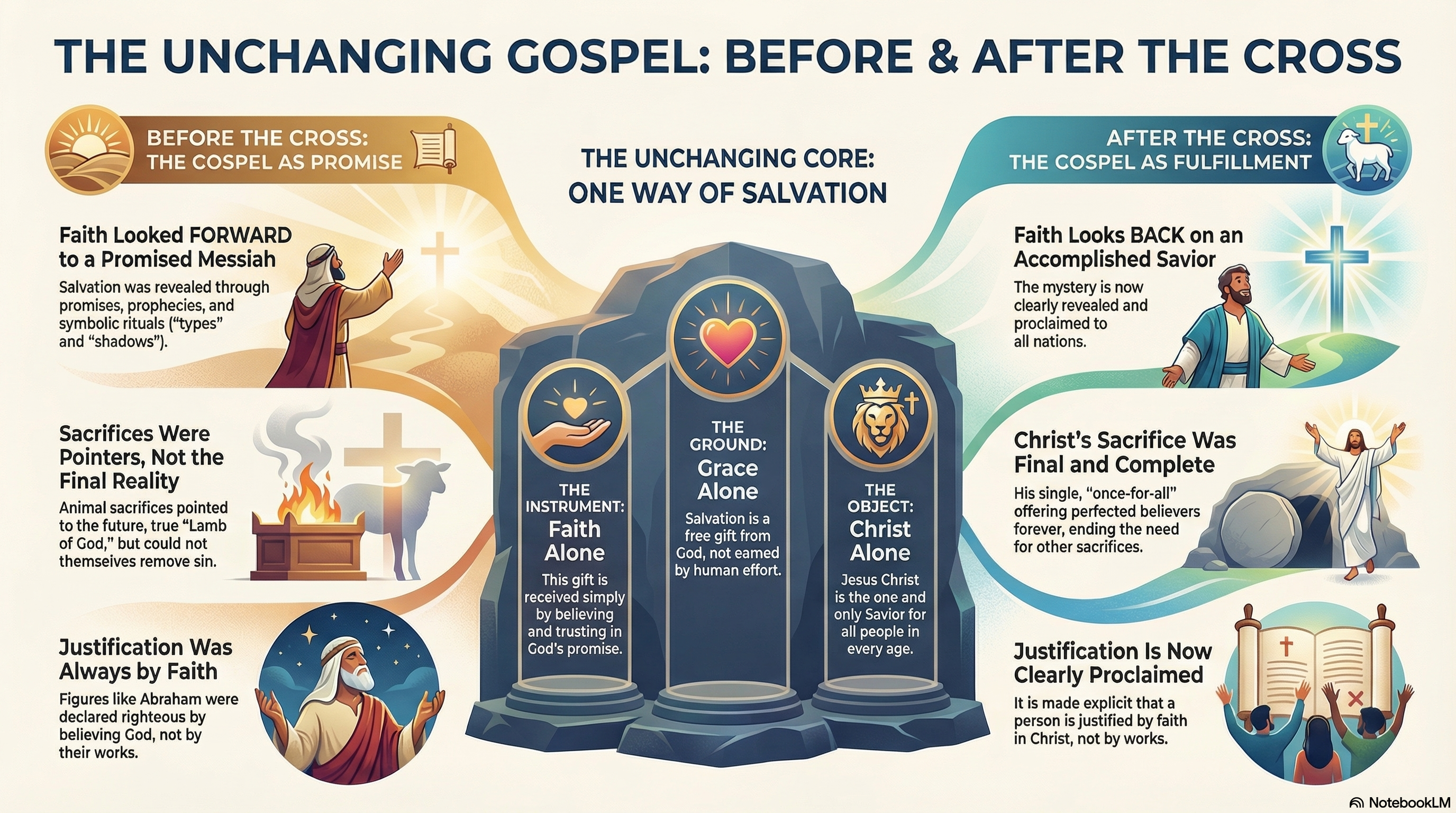
Scripture declares that God saves sinners **by grace alone, through faith alone, in Jesus Christ alone**, without alteration across redemptive history. Before the incarnation, faith looked to the **Messiah promised**; after His life, death, and resurrection, faith rests on the **Messiah accomplished**—the same Christ more clearly revealed: “Jesus Christ the same yesterday, and to day, and for ever.” (Hebrews 13:8) “For unto us was the gospel preached, as well as unto them…” (Hebrews 4:2) By the apostolic hermeneutic, this unity of salvation reflects the one covenant of grace diversely administered.  
---
## 1) One Way of Salvation Across the Ages
**Abraham and the fathers.** Scripture establishes justification by faith before Sinai: “And he believed in the LORD; and he counted it to him for righteousness.” (Genesis 15:6) Paul expounds the same principle with apostolic clarity: “But to him that worketh not, but believeth on him that justifieth the ungodly, his faith is counted for righteousness.” (Romans 4:5; cf. 4:3–4) David bears identical witness (Psalm 32), cited by Paul: “Blessed are they whose iniquities are forgiven, and whose sins are covered. Blessed is the man to whom the Lord will not impute sin.” (Romans 4:7–8)
**The prophets.** The prophetic canon teaches faith as the instrument of life: “The just shall live by his faith.” (Habakkuk 2:4) Peter summarizes the prophetic chorus: “To him give all the prophets witness, that through his name whosoever believeth in him shall receive remission of sins.” (Acts 10:43)
**Christ Himself the object of saving faith.** The patriarchal hope terminates on Christ: “Your father Abraham rejoiced to see my day: and he saw it, and was glad.” (John 8:56) After the resurrection the Lord authoritatively interprets the Scriptures: “Beginning at Moses and all the prophets, he expounded unto them in all the scriptures the things concerning himself.” (Luke 24:27; cf. 24:44–47)
**The cross retroactively and prospectively effective.** The apostolic argument teaches that God set forth Christ “to be a propitiation through faith in his blood… for the remission of sins that are past, through the forbearance of God” (Romans 3:25–26), so that by His death He redeemed “the transgressions that were under the first testament.” (Hebrews 9:15) Thus the one Mediator secures salvation for all the called in every age, confirming the unity of the covenant of grace under its several administrations.  
---
## 2) Before the Cross: Promise, Types, and Shadows
**Promise.** The gospel was preached beforehand to Abraham: “In thee shall all nations be blessed.” (Galatians 3:8) From the first evangel (Genesis 3:15) onward, salvation came by faith in the coming Seed.
**Types.** The tabernacle, priesthood, sacrifices, and festivals functioned as **shadows** of the substance to come: “For the law having a shadow of good things to come… can never with those sacrifices… make the comers thereunto perfect.” (Hebrews 10:1) “For it is not possible that the blood of bulls and of goats should take away sins.” (Hebrews 10:4) These rites directed faith beyond themselves to the true Lamb: “Behold the Lamb of God, which taketh away the sin of the world.” (John 1:29) By covenantal continuity, the former ordinances served the same Christ whom the New Testament reveals with greater fullness and efficacy. 
**Presence.** Israel’s wilderness provision was Christ-centered: “They drank of that spiritual Rock that followed them: and that Rock was Christ.” (1 Corinthians 10:4) The apostolic writers identify this as an administration of the same covenantal grace oriented to the promised Messiah. 
---
## 3) After the Cross: Fulfillment and Clarity
**Once-for-all atonement.** Scripture teaches the finality of Christ’s priestly work: “By the which will we are sanctified through the offering of the body of Jesus Christ once for all.” “But this man, after he had offered one sacrifice for sins for ever, sat down on the right hand of God… For by one offering he hath perfected for ever them that are sanctified.” (Hebrews 10:10; Hebrews 10:12, 14)
**Universal proclamation.** What was promised is now openly published to all nations: the mystery “kept secret since the world began… is made manifest… made known to all nations for the obedience of faith.” (Romans 16:25–26)
---
## 4) Same Ground, Same Instrument, Same Object
* **Ground.** Salvation rests on the **grace** of God in Christ alone. “For by grace are ye saved through faith… not of works, lest any man should boast.” (Ephesians 2:8–9)
* **Instrument.** **Faith** alone, never the works of the law, is the instrument of justification: “Knowing that a man is not justified by the works of the law, but by the faith of Jesus Christ.” (Galatians 2:16)
* **Object.** **Christ** alone is the Savior: “Neither is there salvation in any other.” “I am the way, the truth, and the life.” (Acts 4:12; John 14:6)
---
## 5) One People of God: Inward Reality Over Mere Lineage
Scripture prioritizes the circumcision of the heart over mere outward lineage: “Circumcise therefore the foreskin of your heart.” “Circumcise yourselves to the LORD, and take away the foreskins of your heart… for all the house of Israel are uncircumcised in the heart.” (Deuteronomy 10:16; Jeremiah 4:4; Jeremiah 9:25–26)
This anticipates the New Covenant promise of inward renewal: “I will put my law in their inward parts, and write it in their hearts.” (Jeremiah 31:33; cf. Ezekiel 36:26–27) Therefore those who belong to Christ—Jew or Gentile—are “Abraham’s seed, and heirs according to the promise.” God has made “one new man” in Him. (Galatians 3:29; Ephesians 2:15; cf. Ephesians 2:14–16; Romans 11:17–24)
---
## 6) Common Objections Answered
**Objection 1: Weren’t Old Testament saints saved by keeping the law?**
**Answer:** Scripture denies justification by law-works: “By the deeds of the law there shall no flesh be justified in his sight.” Abraham was justified by faith, and David describes forgiveness apart from works. The law exposes sin and tutors to Christ. (Romans 3:20; Romans 4:2–5; Romans 4:7–8; cf. Galatians 3:24)
**Objection 2: Did sacrifices themselves forgive sins?**
**Answer:** No. The sacrificial system functioned as shadow and pedagogue; forgiveness rests on Christ’s once-for-all offering, applied beforehand by promise. (Hebrews 10:1, 4; Romans 3:25; Hebrews 9:15)
**Objection 3: Was the new birth only a New Testament reality?**
**Answer:** Regeneration by the Spirit has always been necessary. Jesus reproved a teacher in Israel for not knowing this: “Except a man be born again, he cannot see the kingdom of God.” David’s prayer likewise presupposes the Spirit’s renewing presence. (John 3:3; cf. John 3:10; Psalm 51:11)
---
## 7) Covenant-Theological Summary
* **Covenant of Redemption:** The Father gave a people to the Son from eternity (cf. John 17:2, 6, 9, 24), guaranteeing the success of His mediatorial work in time.
* **Covenant of Works:** In Adam all die (Romans 5:12–19). The law condemns; it cannot justify (Romans 3:20).
* **Covenant of Grace:** Immediately after the fall (Genesis 3:15), God revealed the promise of the coming Seed. Throughout the Old Testament this grace was administered by promises, prophecies, types, and sacrifices; in the New Testament it is fulfilled in Christ crucified and risen, proclaimed to all nations. Salvation in every age is the same: **grace in Christ received by faith** (Romans 3:25–26; Hebrews 9:15; Galatians 3:8).
---
## 8) How to Read Your Bible in Light of One Gospel
1. **Follow the promises** (Genesis 3:15; 12:3; 22:18; 2 Samuel 7:12–16) to Christ (Luke 24:27).
2. **See the shadows** (Leviticus; Numbers; feasts) as road signs toward the cross (Hebrews 10:1–4).
3. **Trace the prophets** announcing a heart-renewing, worldwide salvation (Jeremiah 31:31–34; Isaiah 49:6; 56:6–7).
4. **Let the apostles interpret the Old Testament for you** (Romans 3–4; Galatians 3; Hebrews 8–10; 1 Peter 1:10–12).
---
## 9) Key Texts to Memorize
* Genesis 15:6; Habakkuk 2:4; John 8:56; Luke 24:27
* Romans 3:25–26; 4:3–5, 7–8; 5:1
* Acts 10:43; Hebrews 4:2; 9:15; 10:1, 4, 10, 12, 14
* Galatians 3:8, 24, 29; Ephesians 2:8–9, 14–16
---
## 10) Application
Because God has always saved by grace through faith in Christ, **you are invited now** to trust Him wholly. Do not rest in your lineage, your law-keeping, or your religious duties. Rest in the once-for-all sacrifice of Jesus and walk by faith. “Therefore being justified by faith, we have peace with God through our Lord Jesus Christ.” (Romans 5:1) Search the Scriptures with this Christ-centered lens: “Search the scriptures… they are they which testify of me.” (John 5:39)
> One Christ, one cross, one people, one gospel—yesterday, today, and forever.