# Why I Am Not a Messianic Jew (A Reformed Reflection)
*By Adam Malin*
*Date: August 23, 2025*
[Audio Overview](https://notebooklm.google.com/notebook/4965541d-9400-40b5-a3c8-ef8db4dcd3b9?artifactId=15a81e19-d382-4359-9d24-c82871d63f36)
[Video Overview](https://youtu.be/rPC6AVODIqM)
I am grateful for Jewish believers who confess that Jesus of Nazareth is the Messiah, and I seek to speak with charity and clarity. My convictions are those of a 1689 Reformed Baptist: Scripture alone rules the conscience, salvation is by grace alone through faith alone in Christ alone, and the New Covenant church, composed of believing Jews and Gentiles, is called to worship and walk according to Christ’s appointments. “Prove all things; hold fast that which is good.” (1 Thessalonians 5:21, KJV)
---
## My Starting Commitments
* **Scripture alone:** “All scripture is given by inspiration of God, and is profitable… That the man of God may be perfect, throughly furnished unto all good works.” (2 Timothy 3:16–17)
* **The gospel of grace:** “Knowing that a man is not justified by the works of the law, but by the faith of Jesus Christ… for by the works of the law shall no flesh be justified.” (Galatians 2:16)
* **One people in Christ:** “There is neither Jew nor Greek… for ye are all one in Christ Jesus. And if ye be Christ’s, then are ye Abraham’s seed.” (Galatians 3:28–29; cf. Ephesians 2:14–16)
* **Lord’s Day worship:** “And upon the first day of the week, when the disciples came together to break bread…” (Acts 20:7); “I was in the Spirit on the Lord’s day.” (Revelation 1:10)
---
## 1) Shadow and Substance
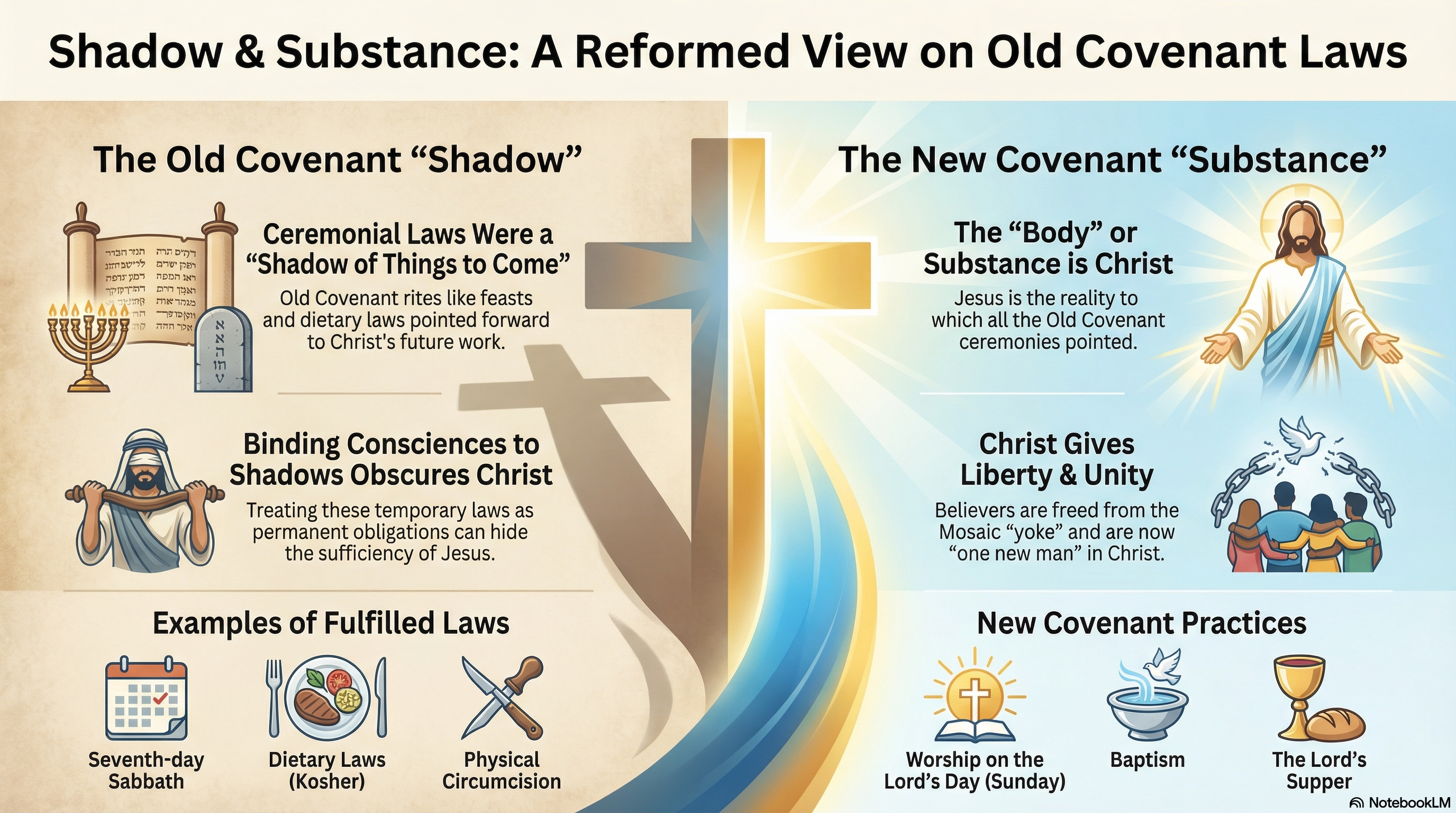
The apostles teach that the ceremonial calendar of the Mosaic covenant was **typological**, true yet temporary, fulfilled in Christ. “Let no man therefore judge you in meat, or in drink, or in respect of an holyday, or of the new moon, or of the sabbath days: Which are a shadow of things to come; but the body is of Christ.” (Colossians 2:16–17) “For the law having a shadow of good things to come… can never… make the comers thereunto perfect.” (Hebrews 10:1)
**Why this matters:** I cannot bind consciences to the Mosaic calendar as covenant obligation without obscuring Christ the **substance**.
---
## 2) The Lord’s Day, Not the Seventh Day
While the **moral** principle of one day in seven abides, the **day** has been changed by Christ’s resurrection to the first day, the Christian Sabbath. “Upon the first day of the week let every one of you lay by him in store.” (1 Corinthians 16:2) “I was in the Spirit on the Lord’s day.” (Revelation 1:10) The day is a gift, not a yoke: “The sabbath was made for man, and not man for the sabbath: Therefore the Son of man is Lord also of the sabbath.” (Mark 2:27–28) We are to call it a delight: “If thou turn away thy foot from the sabbath… and call the sabbath a delight… then shalt thou delight thyself in the LORD.” (Isaiah 58:13–14)
**Why this matters:** I cannot affirm seventh‑day obligation under the New Covenant when the apostolic pattern is the first day gathered worship (Acts 20:7).
---
## 3) Feasts and Calendars Are Not Gospel Requirements
The Jerusalem Council refused to put the Mosaic yoke on Gentile believers: “Now therefore why tempt ye God, to put a yoke upon the neck of the disciples…? But we believe that through the grace of the Lord Jesus Christ we shall be saved, even as they.” (Acts 15:10–11) Paul warns against calendar bondage: “Ye observe days, and months, and times, and years. I am afraid of you, lest I have bestowed upon you labour in vain.” (Galatians 4:10–11)
**Why this matters:** I can appreciate a teaching Seder, yet I cannot treat feast‑keeping as covenant‑binding or as a test of maturity.
---
## 4) Dietary Laws Fulfilled in Christ
“What God hath cleansed, that call not thou common.” (Acts 10:15) “I know, and am persuaded by the Lord Jesus, that there is nothing unclean of itself.” (Romans 14:14) “For every creature of God is good, and nothing to be refused, if it be received with thanksgiving.” (1 Timothy 4:4–5)
**Why this matters:** Kosher as a cultural practice is one thing; kosher as a moral obligation for Christians undermines New Covenant freedom.
---
## 5) Circumcision and Covenant Identity
Paul is plain: “Circumcision is nothing, and uncircumcision is nothing, but the keeping of the commandments of God.” (1 Corinthians 7:19) “Stand fast therefore in the liberty wherewith Christ hath made us free… For I testify again to every man that is circumcised, that he is a debtor to do the whole law.” (Galatians 5:1, 3)
**Why this matters:** I cannot view circumcision as necessary to belong fully to the people of God. Christ is sufficient.
---
## 6) Sacred‑Name or Hebrew‑Only Tests
Insisting that one must use Hebrew pronunciations to be right with God creates man‑made tests. “Neither is there salvation in any other: for there is **none other name** under heaven given among men, whereby we must be saved.” (Acts 4:12) “Whatsoever ye do in word or deed, do all in the name of the Lord Jesus.” (Colossians 3:17)
**Why this matters:** The question is not the syllables but the **Saviour**.
---
## 7) Worship Regulated by Scripture, Not by Restored Ceremonies
God alone determines acceptable worship. “What thing soever I command you, observe to do it: thou shalt not add thereto, nor diminish from it.” (Deuteronomy 12:32) “God is a Spirit: and they that worship him must worship him in spirit and in truth.” (John 4:24) Human inventions have a show of wisdom but lack true spiritual power (cf. Colossians 2:23). “Let all things be done decently and in order.” (1 Corinthians 14:40)
**Why this matters:** I cannot import Old‑Covenant rites as if required for Christian worship. Christ instituted preaching, prayer, singing, baptism, and the Lord’s Supper.
---
## 8) Israel and the Church, Unity in Christ
In Christ, God has made “of twain one new man.” (Ephesians 2:15) “There is neither Jew nor Greek… for ye are all one in Christ Jesus. And if ye be Christ’s, then are ye Abraham’s seed.” (Galatians 3:28–29)
**Why this matters:** I cannot embrace systems that re‑erect the dividing wall or imply a two‑track covenant standing.
---
## 9) No Return to Temple Sacrifices
Christ’s atonement is final. “But now once in the end of the world hath he appeared to put away sin by the sacrifice of himself.” (Hebrews 9:26) “But this man, after he had offered **one sacrifice for sins for ever**, sat down on the right hand of God.” (Hebrews 10:12)
**Why this matters:** Any vision of renewed atoning sacrifices undermines the once‑for‑all work of Christ.
---
## 10) Passover and the Lord’s Supper
The Passover pointed forward; the Lord’s Supper proclaims the finished work. “This is my body, which is broken for you… This cup is the new testament in my blood… this do ye… in remembrance of me.” (1 Corinthians 11:24–25)
**Why this matters:** I welcome Christ‑centered instruction from the Exodus story, but in corporate worship I keep the ordinance Christ commanded.
---
## 11) Signs and Sufficiency
The foundational, apostolic signs confirmed the message (cf. Hebrews 2:3–4; 2 Corinthians 12:12). With Scripture complete, God’s Word is sufficient: “All scripture is given by inspiration of God… That the man of God may be perfect, throughly furnished unto all good works.” (2 Timothy 3:16–17)
**Why this matters:** I test all claims of continuing revelatory authority by the closed canon and the order of Christ’s church.
---
## A Note on “Babylonian” Accusations
It is unhelpful to label Jewish customs as “Babylonian” as if origin alone settles the question. Jesus condemns elevating human tradition above God’s Word: “Full well ye reject the commandment of God, that ye may keep your own tradition.” (Mark 7:9; cf. 7:13) Paul warns against being taken captive “after the tradition of men… and not after Christ.” (Colossians 2:8) The issue is always this: **Does the practice magnify Christ and accord with Scripture, or does it bind where God has not?**
---
## How I Seek to Walk Instead
1. **Keep the Lord’s Day holy** in gathered worship and grateful rest (Acts 20:7; Revelation 1:10; Isaiah 58:13–14).
2. **Center church life on Christ’s ordinances**, baptism and the Lord’s Supper, rather than Old‑Covenant ceremonies (Matthew 28:19–20; 1 Corinthians 11:23–26).
3. **Guard Christian liberty** in matters of food and days without making them tests of standing (Romans 14:5–6, 14; Colossians 2:16–17).
4. **Pursue unity in the truth,** remembering that in Christ we are one new man (Ephesians 2:14–16; Galatians 3:28–29).
5. **Ask for wisdom** as I weigh practices: “If any of you lack wisdom, let him ask of God… and it shall be given him.” (James 1:5)
---
## Conclusion
I love my Messianic Jewish neighbors in Christ and rejoice whenever the name of Jesus is confessed. Yet for the sake of the gospel’s sufficiency, the church’s unity, and a conscience captive to Scripture, I cannot adopt a system that re‑imposes Mosaic ceremonies or binds where Christ has made free. “Stand fast therefore in the liberty wherewith Christ hath made us free.” (Galatians 5:1) “Prove all things; hold fast that which is good.” (1 Thessalonians 5:21)