# Apostolic Hermeneutic
**How the Apostles Teach Us to Read the Whole Bible: A Practical Guide for Reformed Believers**
---
*By Adam Malin*
*Date: August 14, 2025*
[Audio Overview](https://notebooklm.google.com/notebook/ff1bea83-5641-47d4-a7e6-0f4025e9a86c?artifactId=f88e9a00-f192-488f-b091-6a1810cfeb4a)
[Video Overview](https://youtu.be/rZpSeV4uJTU)
## Thesis
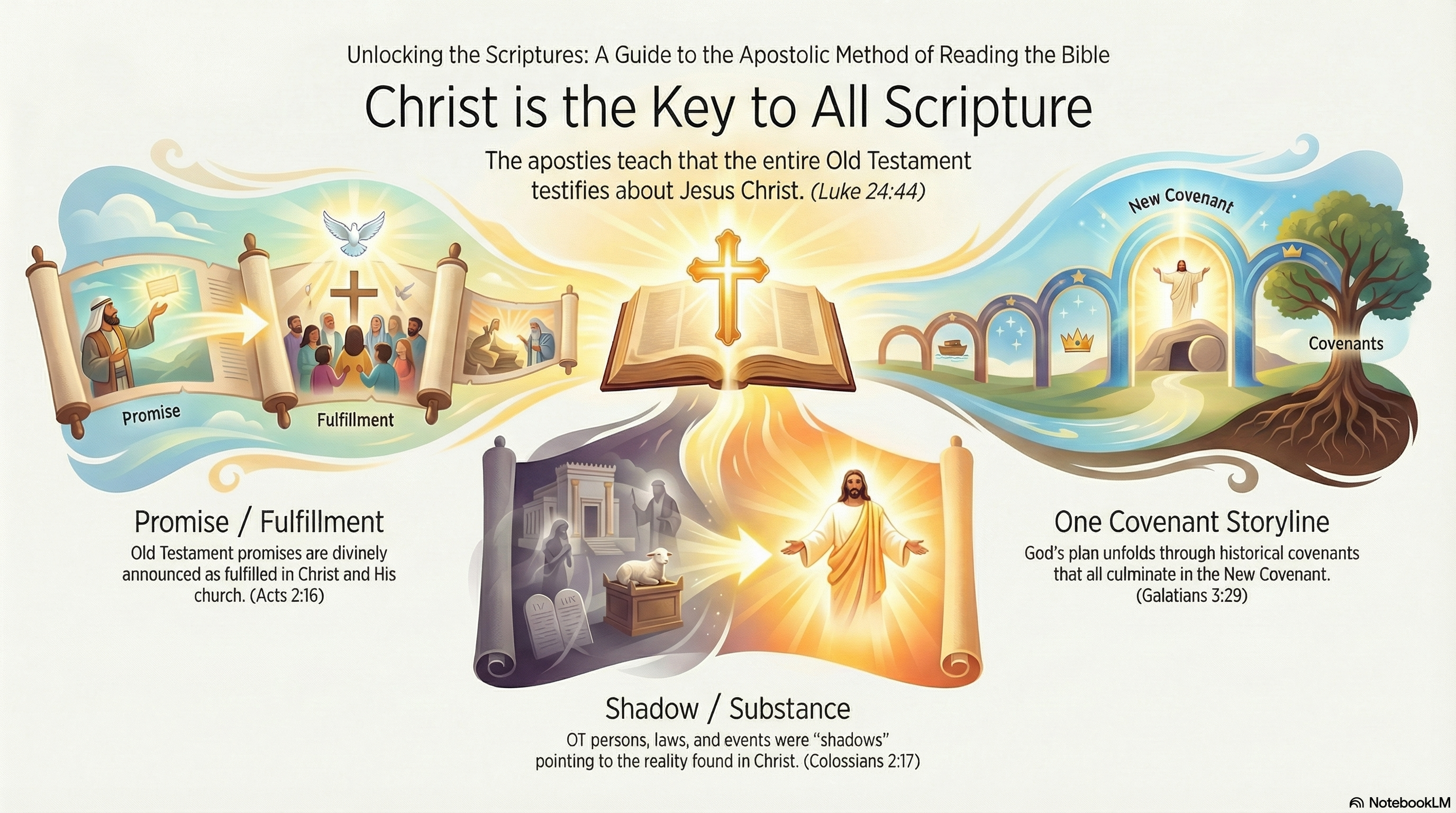
Scripture teaches that the New Testament does not merely cite the Old; it authoritatively **shows how to read it**. The risen Christ “beginning at Moses and all the prophets…expounded…in all the scriptures the things concerning himself,” and He “opened…their understanding, that they might understand the scriptures” (Luke 24:27; Luke 24:45, KJV). The apostolic writings carry forward this Christ-centered hermeneutic (Hebrews 1:1–2; 2 Timothy 3:14–17). Therefore, interpretation proceeds **exegesis first, within the one covenant of grace**, with Christ as the yes and amen of all divine promises (2 Corinthians 1:20; Galatians 3:16, 29).
> “**And beginning at Moses and all the prophets, he expounded unto them in all the scriptures the things concerning himself.**” (Luke 24:27, KJV)
> “**Then opened he their understanding, that they might understand the scriptures.**” (Luke 24:45, KJV)
---
## Method: Exegesis before Systems
1. **Read the words in their literary and historical context.** Scripture requires giving “the sense” so that the people understand (Nehemiah 8:8). Christ Himself asks, “What is written in the law? **How readest thou?**” (Luke 10:26). Apostolic expectation is that meaning is grasped by careful reading (Ephesians 3:4).
2. **Let the clear interpret the less clear (the “analogy of faith”).** Peter acknowledges “some things hard to be understood” in Scripture (2 Peter 3:16), so the infallible rule is Scripture interpreting Scripture (Acts 15:15; John 5:39). The Confession summarizes: “The infallible rule of interpretation of Scripture is the Scripture itself” (WCF I.9). 
3. **Track the covenants in redemptive history.**
* **Creation/Works:** Life was promised upon perfect and personal obedience to the command (Genesis 2:16–17; Romans 5:12–19; Galatians 3:12).
* **Abraham:** The gospel was preached beforehand to Abraham; the promised **Seed** is Christ (Genesis 12:3; Genesis 15; Galatians 3:8, 16).
* **Sinai/Moses:** The law served as a pedagogue unto Christ and as a typological administration (Exodus 19:3–6; Galatians 3:19–25; Hebrews 10:1).
* **David:** The kingdom promise culminates in David’s greater Son (2 Samuel 7:12–16; Acts 2:30–36).
* **New:** In Christ’s blood the new covenant is inaugurated (Jeremiah 31:31–34; Luke 22:20; Hebrews 8:6–13).
By covenantal continuity there is **one covenant of grace** under diverse administrations (Galatians 3:14, 29; Ephesians 2:11–22; Hebrews 13:20; WCF VII.3, 5–6). The apostolic writers thereby ground sacramental continuity: **baptism succeeds circumcision** as the initiatory sign, and the **Lord’s Supper** confirms the same grace formerly shadowed by Passover (Colossians 2:11–12; Acts 2:39; 1 Corinthians 5:7; 1 Corinthians 11:23–26).
4. **Move from shadow to substance only as Scripture itself does.** The law’s rites were “a shadow of good things to come,” the **body** being Christ (Colossians 2:17; Hebrews 8:5; 10:1). Hebrews declares the finality of Christ’s one sacrifice, disannulling the former commandment and excluding any return to bloody offerings (Hebrews 7:18–19; 10:10–14, 18).
5. **Submit to apostolic interpretation as norming.** Where the New Testament explains the Old, that inspired exegesis governs the Church’s reading. Examples include:
* **Pentecost:** Joel 2 applied to the last days outpouring (Acts 2:16–21).
* **The nations gathered:** Amos 9 read as the present rebuilding of David’s fallen tent in Christ (Acts 15:13–18).
* **Son-out-of-Egypt:** Hosea 11:1 read typologically in Christ (Matthew 2:15).
* **Abrahamic promise:** “In thee shall all nations be blessed” interpreted as gospel proclamation to the Gentiles; Christ is the singular Seed (Galatians 3:8, 16).
* **People of God reconstituted:** Hosea applied to Jew and Gentile called into one people (Romans 9:24–26).
* **New covenant realized:** Jeremiah 31 cited to assert the better ministry of Christ (Hebrews 8:6–13).
By the apostolic method, **Scripture interprets Scripture; type yields to antitype; promise finds fulfillment in Christ** (Luke 24:27; John 5:39).
**Summary:** Scripture itself, read in context and by the apostolic rule, yields a Christ-centered, covenantally continuous interpretation that accords with the doctrines of grace—God’s sovereign election, effectual calling, and the finality of Christ’s mediatorship (Ephesians 1:3–14; John 6:37–39; Hebrews 9:11–15).
---
## The Apostolic Hermeneutic in Six Pillars
### 1) Christ the Key
Scripture teaches that Christ is the center and climax of the whole canon. The risen Lord declares that “all things…written in the law of Moses, and in the prophets, and in the psalms” are **concerning Him** (Luke 24:44, KJV). The apostles confess that “to him give **all the prophets** witness” and that “all the promises of God in him are yea, and in him Amen” (Acts 10:43; 2 Corinthians 1:20, KJV). God, who “spake in time past unto the fathers by the prophets,” has “in these last days spoken unto us by his Son,” establishing Christ as the definitive interpreter and fulfillment of the Scriptures (Hebrews 1:1–2, KJV; John 5:39).
> “**These are the words which I spake unto you… that all things must be fulfilled, which were written in the law of Moses, and in the prophets, and in the psalms, concerning me.**” (Luke 24:44, KJV)
> “**For all the promises of God in him are yea, and in him Amen.**” (2 Corinthians 1:20, KJV)
**Practice:** In every passage, identify how the text reveals Christ’s **person** (true God and true man), **work** (obedience, death, resurrection, ascension), **offices** (Prophet, Priest, King), and **benefits** dispensed in the new covenant (remission of sins, new heart, Spirit’s indwelling), in keeping with the apostolic claim that the Scriptures testify of Him (John 5:39; Luke 24:27; Jeremiah 31:31–34; Luke 22:20; Hebrews 9:11–15).
---
### 2) Promise → Fulfilment
The apostolic method traces promises through redemptive history to their divinely announced fulfillments in Christ and His Church. Peter’s Pentecost preaching identifies Joel’s prophecy as presently realized: “**This is that**” (Acts 2:16–21, KJV). Matthew reads Israel’s story as terminating in Christ, citing Hosea 11:1 with “Out of Egypt have I called my son” (Matthew 2:15, KJV). Paul proclaims, “the promise which was made unto the fathers, God hath fulfilled the same unto us their children” in the resurrection and enthronement of Jesus (Acts 13:32–33, KJV), and he asserts that Christ came “to confirm the promises made unto the fathers; and that the Gentiles might glorify God for his mercy” (Romans 15:8–9, KJV).
> “**But this is that which was spoken by the prophet Joel.**” (Acts 2:16, KJV)
**Practice:** Locate the promise in its original setting and covenantal place; trace its canonical development; then note where and how the New Testament **announces** fulfillment—already in Christ’s first advent and the outpouring of the Spirit (Acts 2:16–18; Hebrews 1:2), and awaiting consummation at His appearing (Acts 3:19–21; 1 Corinthians 15:22–28). Distinguish proximate (typological or preliminary) fulfillments from climactic fulfillment in the Mediator, while confessing that the Spirit is the “earnest” of the promised inheritance until the redemption of the purchased possession (Ephesians 1:13–14, KJV).
---
### 3) Typology: From Shadow to Substance
The apostles treat Old Testament persons, institutions, and ceremonies as **true history** ordered by God to foreshadow Christ and His benefits. “Which are a shadow of things to come; but the body is of Christ” (Colossians 2:17, KJV). “The law having a shadow of good things to come” is contrasted with the efficacy of Christ’s once-for-all offering (Hebrews 10:1, 10–14, 18, KJV). They explicitly state that these events “happened unto them for **ensamples**” (types), “and they are written for our admonition” (1 Corinthians 10:11, KJV). The temple yields to Christ’s body (John 2:19–21), the priesthood to His unchangeable priesthood (Hebrews 7:23–28), Passover to “Christ our passover…sacrificed for us” (1 Corinthians 5:7, KJV), and the exodus pattern to the greater redemption He accomplishes (Luke 9:31; Hebrews 2:14–15).
> “**Which are a shadow of things to come; but the body is of Christ.**” (Colossians 2:17, KJV)
> “**For the law having a shadow of good things to come, and not the very image of the things…**” (Hebrews 10:1, KJV)
**Practice:** Receive each type according to its own historical and covenantal function (tabernacle/temple, priest, sacrifice, king); then follow the inspired identifications of the **antitype** in Christ and His Church (John 2:21; Hebrews 7–10; 1 Peter 2:4–10). By the apostolic rule, do not reinstate the shadows after the substance has come; Hebrews disannuls the former commandment and excludes any future return to bloody offerings (Hebrews 7:18–19; 10:1–4, 10–14, 18).
---
### 4) The Covenant Storyline
Scripture teaches that redemption advances by covenants, reaching its telos in the new covenant ratified in Christ’s blood. The first gospel promise declares a conquering Seed who will crush the serpent (Genesis 3:15). God then administers the same grace covenantally through Abraham, narrowing the promise to a singular Seed—Christ—by whom the nations are blessed (Genesis 12:3; Genesis 15; Genesis 22:17–18; Galatians 3:8, 16). The Sinai administration serves as a pedagogue, multiplying types and shadows that drive to Christ (Exodus 19:3–6; Galatians 3:19–25; Hebrews 10:1). The Davidic covenant further focuses the hope on the enthroned Son (2 Samuel 7:12–16; Acts 2:30–36). In the fullness of time, Christ inaugurates the new covenant, effecting the promised forgiveness and new heart by His once-for-all sacrifice (Jeremiah 31:31–34; Luke 22:20; Hebrews 8:6–13; Hebrews 9:11–15). By covenantal continuity, all who are united to Christ—Jew and Gentile—are Abraham’s seed and heirs according to promise (Galatians 3:29; Ephesians 2:11–22). Thus the land motif opens out to the better country and the world-inheritance (Hebrews 11:9–16; Romans 4:13), the temple to Christ and His body, the Church (John 2:19–21; Ephesians 2:19–22), and the kingdom to the Mediator’s present reign and final consummation (Psalm 110:1; Acts 2:33–36; 1 Corinthians 15:24–28).
> “**And I will put enmity between thee and the woman… it shall bruise thy head, and thou shalt bruise his heel.**” (Genesis 3:15, KJV)
> “**Now to Abraham and his seed were the promises made… And to thy seed, which is Christ.**” (Galatians 3:16, KJV)
> “**And if ye be Christ’s, then are ye Abraham’s seed, and heirs according to the promise.**” (Galatians 3:29, KJV)
**Practice:** Identify the covenantal location of any passage (Adam, Abraham, Sinai, David, New). Then note what is **fulfilled** and what is **transformed** at Christ’s inauguration of the new covenant: the ceremonial law and priesthood cease as shadows (Hebrews 7:12, 18–19; 10:9–14), while the moral law abides as the rule of life (Matthew 5:17–19; Romans 3:31). By covenantal continuity, baptism succeeds circumcision as the initiatory sign and the Lord’s Supper confirms the same saving grace once shadowed by Passover (Colossians 2:11–12; Acts 2:39; 1 Corinthians 5:7; 1 Corinthians 11:23–26).
---
### 5) Scripture Interprets Scripture
The apostolic pattern is canonical cross-reading in which the Spirit uses the whole canon to interpret its parts. The events “happened unto them for **ensamples** (types)” and were “written for our admonition” (1 Corinthians 10:11, KJV); the things “written aforetime were written for our learning” (Romans 15:4, KJV); and prophecy is not of private origination but given by men “moved by the Holy Ghost” (2 Peter 1:20–21, KJV). Accordingly, the New Testament’s explanations norm the Church’s handling of contested Old Testament themes:
* **People:** One covenant people in Christ—“a chosen generation,” Jew and Gentile together (Hosea 2:23 applied in Romans 9:24–26; 1 Peter 2:9–10; Galatians 3:28–29).
* **Land/Rest:** Canaan typifies a better, heavenly rest; the promise expands to the world (Hebrews 3:7–4:11; Romans 4:13).
* **Temple:** The antitypical temple is Christ and, in Him, the Church as God’s dwelling (John 2:21; Ephesians 2:19–22; 1 Peter 2:4–6).
* **Kingdom/Throne:** The Davidic throne is realized in Christ’s present exaltation and will be consummated at His appearing (Acts 2:30–36; Hebrews 12:28; 1 Corinthians 15:24–28).
> “**Now all these things happened unto them for ensamples: and they are written for our admonition…**” (1 Corinthians 10:11, KJV)
> “**For whatsoever things were written aforetime were written for our learning…**” (Romans 15:4, KJV)
> “**Knowing this first, that no prophecy of the scripture is of any private interpretation…**” (2 Peter 1:20–21, KJV)
**Practice:** Where the apostles interpret the Old Testament, receive that inspired reading as controlling. Let these interpretations discipline conclusions about people, land, temple, and kingdom, so that type yields to antitype and shadow to substance (Luke 24:27; Acts 15:14–18; Hebrews 8:5; Colossians 2:17).
---
### 6) Already and Not Yet (Inauguration and Consummation)
The apostolic witness locates the Church between accomplishment and consummation. Christ now reigns and is subduing His enemies, yet “we see not yet all things put under him” (1 Corinthians 15:25; Hebrews 2:8, KJV). He has been enthroned at the Father’s right hand (Psalm 110:1; Acts 2:33–36), all authority has been given to Him (Matthew 28:18), and believers have been translated into His kingdom (Colossians 1:13). The Spirit is the “earnest” of the inheritance until the redemption of the purchased possession (Ephesians 1:13–14, KJV). The same Scriptures fix hope on the last day when death is destroyed, the creation renewed, and faith gives way to sight (1 Corinthians 15:22–28, 50–57; Romans 8:18–25; Revelation 21:1–5).
> “**For he must reign, till he hath put all enemies under his feet.**” (1 Corinthians 15:25, KJV)
> “**But now we see not yet all things put under him.**” (Hebrews 2:8, KJV)
**Practice:** Expect present realizations of promised blessings—Spirit outpoured, new heart, the nations gathered into one people (Acts 2:16–18; Ezekiel 36:26–27; Ephesians 2:11–22)—while ordering life and worship toward the blessed hope of Christ’s appearing and the resurrection of the dead (Titus 2:13; Philippians 3:20–21; 1 Thessalonians 4:13–18).
---
## Guided Walkthroughs (Do-It-Now Case Studies)
### A) Pentecost and Joel 2 — *Acts 2:14–21*
**Context:** The exalted Christ has ascended to the right hand of the Father and **pours out** the promised Spirit (Acts 2:32–33; Luke 24:49; Acts 1:4–5). Peter interprets the event covenantally: the **“last days”** have begun with Christ’s enthronement (Acts 2:17; Hebrews 1:2).
**Apostolic claim:** “**This is that** which was spoken by the prophet Joel” (Acts 2:16, KJV). The Spirit’s effusion upon “all flesh” marks the new-covenant age of prophetic fullness, priestly access, and royal witness (Joel 2:28–32; Numbers 11:29 fulfilled; cf. Jeremiah 31:33–34; Ezekiel 36:26–27).
**Payoff:** The Church is the Spirit-indwelt people of the latter days; the mission is universal until “the great and notable day of the Lord,” and “**whosoever shall call on the name of the Lord shall be saved**” (Acts 2:17–21, KJV; Acts 1:8).
> “**And it shall come to pass in the last days, saith God, I will pour out of my Spirit upon all flesh…**” (Acts 2:17, KJV)
**How to imitate the apostolic pattern:**
1. **Identify the promise** in its original context (Joel 2:28–32).
2. **Locate the Christ-event** that unlocks it (resurrection, ascension, session, outpouring; Acts 2:32–36).
3. **Situate discipleship** between Pentecost and Parousia—bold proclamation now, patient hope for the consummation then (Acts 3:19–21; 1 Corinthians 15:24–28).
---
### B) The Gentiles and Amos 9 — *Acts 15:13–18*
**Question:** Must Gentiles be made Jews—taking the yoke of Moses—to be saved? (Acts 15:1, 5).
**Apostolic answer:** God is presently **visiting the nations to take out of them a people for His name**, exactly as He promised. James cites the prophets (summarizing Amos 9:11–12) to declare the Messiah’s restorative reign **now** gathering the Gentiles: “**I will build again the tabernacle of David… that the residue of men might seek after the Lord, and all the Gentiles, upon whom my name is called**” (Acts 15:14–17, KJV).
**Payoff:** The wall between Jew and Gentile is not rebuilt. In Christ there is **one new man**, one household, one holy temple (Ephesians 2:14–22). Salvation is by grace through faith apart from the Mosaic yoke (Acts 15:10–11, 19, 28–29; Galatians 2:16). This confirms the Abrahamic design: the nations blessed in the promised Seed (Genesis 12:3; Galatians 3:8, 16, 29).
> “**After this I will return, and will build again the tabernacle of David… That the residue of men might seek after the Lord, and all the Gentiles, upon whom my name is called…**” (Acts 15:16–17, KJV)
**How to imitate the apostolic pattern:**
1. **Read promise by promise** in their covenantal frame (Amos 9:11–12 within the Davidic hope).
2. **Let apostolic fulfillment govern**—Christ’s present enthronement gathers the nations without imposing the ceremonial law (Acts 2:30–36; Acts 15:19–21).
3. **Apply the ecclesial implication**—receive believers from the nations as fellow-citizens and living stones in the same temple (Ephesians 2:19–22; 1 Peter 2:4–10).
---
### C) Abraham’s Promise — *Genesis 12; 15; 17 → Galatians 3*
**Observation (Textual):** God grants Abraham promises of **seed** and **inheritance**, ratified by covenant oath (Genesis 12:1–3; Genesis 15:5–6, 18; Genesis 17:7–8). Abraham believes, and it is counted to him for righteousness (Genesis 15:6; Romans 4:3–5).
**Apostolic reading:** Scripture foresaw the justification of the nations through faith and “preached before the gospel unto Abraham” (Galatians 3:8, KJV). The promise terminates in a singular Seed—**Christ**—and extends to **all who are in Christ** by faith-union: “To thy seed, which is Christ” (Galatians 3:16, KJV); “If ye be Christ’s, then are ye Abraham’s seed, and heirs according to the promise” (Galatians 3:29, KJV). Paul further declares that the inheritance is **enlarged**, not narrowed: “the promise, that he should be the **heir of the world**” comes “through the righteousness of faith” (Romans 4:13, KJV). Thus, covenant membership is defined by union with the promised Seed, not by ethnic descent (Galatians 3:26–29).
> “**And the scripture, foreseeing that God would justify the heathen through faith…**” (Galatians 3:8, KJV)
> “**Now to Abraham and his seed were the promises made… And to thy seed, which is Christ.**” (Galatians 3:16, KJV)
> “**And if ye be Christ’s, then are ye Abraham’s seed, and heirs according to the promise.**” (Galatians 3:29, KJV)
**Payoff:** The inheritance grows—Canaan typologically opens to “the world,” culminating in the new creation (Romans 4:13; Hebrews 11:9–16; Revelation 21:1–5).
**Practice:** In any Abrahamic text, (1) identify promise, oath, and sign; (2) follow the apostolic focus to the **Seed**, Christ; (3) read the inheritance along the promise→fulfilment line from land-type to world/new-creation reality for all who believe (Galatians 3:8, 16, 29; Romans 4:13).
---
### D) Temple and Sacrifice — *Leviticus → John 2; Hebrews 8–10; Revelation 21*
**Type (Levitical economy):** Priesthood, sanctuary, and sacrifices mediate access by divinely appointed shadows (Leviticus 1–7; Hebrews 10:1).
**Antitype (Christ and His body):** Christ identifies Himself as the true temple—“he spake of the temple of his body” (John 2:19–21, KJV). He obtains a “more excellent ministry,” mediating a **better covenant** founded upon better promises (Hebrews 8:6, KJV). By His once-for-all offering He perfects His people and brings remission of sins such that “there is **no more offering for sin**” (Hebrews 10:10–14, 18, KJV). The new covenant thereby renders the first **old** and ready to vanish (Hebrews 8:13). The eschatological city has **no temple** because “the Lord God Almighty and the Lamb are the temple of it” (Revelation 21:22, KJV).
> “**Destroy this temple, and in three days I will raise it up… But he spake of the temple of his body.**” (John 2:19, 21, KJV)
> “**But now hath he obtained a more excellent ministry… the mediator of a better covenant…**” (Hebrews 8:6, KJV)
> “**In that he saith, A new covenant, he hath made the first old.**” (Hebrews 8:13, KJV)
> “**Now where remission of these is, there is no more offering for sin.**” (Hebrews 10:18, KJV)
> “**And I saw no temple therein: for the Lord God Almighty and the Lamb are the temple of it.**” (Revelation 21:22, KJV)
**Payoff:** The sacrificial economy ends **by fulfilment**. Shadow yields to substance; priesthood and offerings cease because Christ’s priestly work is final and effectual (Colossians 2:17; Hebrews 7:18–19; 10:1–4, 10–14).
**Practice:** Read Leviticus historically and typologically: receive each ordinance on its own terms, then trace its appointed goal in Christ’s body, priesthood, and cross. In worship, draw near “by a new and living way” through the veil of His flesh (Hebrews 10:19–22).
---
### E) Israel’s Identity and the Church — *Exodus 19 → 1 Peter 2*
**Apostolic application:** Titles given to Israel at Sinai—“a kingdom of priests, and an holy nation” (Exodus 19:5–6)—are applied by the apostles to the multi-ethnic people united to Christ: “a chosen generation, a royal priesthood, an holy nation, a peculiar people” (1 Peter 2:9, KJV). Hosea’s “not my people” becomes, in Christ, “now the people of God” (1 Peter 2:10; Hosea 2:23; Romans 9:24–26). The Church, built of living stones upon Christ the cornerstone, is God’s dwelling (1 Peter 2:4–6; Ephesians 2:19–22). Thus the apostolic hermeneutic refuses to re-erect the wall between Jew and Gentile; in the Mediator there is **one new man** and one household (Ephesians 2:14–16, 19).
> “**But ye are a chosen generation, a royal priesthood, an holy nation, a peculiar people… Which in time past were not a people, but are now the people of God.**” (1 Peter 2:9–10, KJV)
**Payoff:** The people-of-God identity is fulfilled and **expanded** in Christ, guarding against a hard Israel/Church separation and against rebuilding what the new covenant has fulfilled (Galatians 3:28–29; Ephesians 2:14–22; Acts 15:14–18).
**Practice:** Let apostolic usage govern ecclesiology: read Exodus 19 through 1 Peter 2; confess one covenant people in Christ; receive believers from the nations as fellow-citizens and living stones; and order worship as a priestly people offering spiritual sacrifices through Jesus Christ (1 Peter 2:5; Romans 12:1).
---
## How to Read Any Passage This Way (A Seven-Step Path)
1. **Locate the passage in history and covenant.** Scripture unfolds “at sundry times and in divers manners,” reaching its fullness “in these last days” in the Son (Hebrews 1:1–2, KJV). Identify author, audience, and the covenantal moment (Adam, Abraham, Sinai, David, New), since the law was a pedagogue unto Christ (Galatians 3:19–25) and the promises narrow to the Seed (Galatians 3:16).
2. **State the human author’s main point.** Give “the sense” so that the meaning is clear (Nehemiah 8:8). Remember that “holy men of God spake as they were moved by the Holy Ghost” (2 Peter 1:21, KJV), and that “all scripture is given by inspiration of God… profitable” according to the writer’s argument (2 Timothy 3:16–17).
3. **Ask the Christ-question.** The Scriptures “testify of” Christ (John 5:39), who expounds “in all the scriptures the things concerning himself” (Luke 24:27). Trace how the text reveals His **person** (John 1:1, 14), **work** (1 Corinthians 15:3–4), **offices**—Prophet (Deuteronomy 18:15; Acts 3:22–26), Priest (Hebrews 7:25–27), King (Psalm 2; Acts 2:30–36)—and His **new-covenant benefits** (Jeremiah 31:31–34; Hebrews 9:11–15).
4. **Check the apostolic cross-references.** Where the New Testament cites, echoes, or develops an Old Testament passage, that inspired interpretation is norming (Acts 15:15–18; Romans 15:4; 1 Corinthians 10:11). The mystery is revealed “unto his holy apostles and prophets by the Spirit” (Ephesians 3:5).
5. **Follow the shadow-to-substance rule.** Move from type to antitype only where Scripture itself does: “a shadow of things to come; but the body is of Christ” (Colossians 2:17, KJV; Hebrews 10:1). The priesthood alters with the change of law (Hebrews 7:12, 18–19); temple, sacrifice, and land reach their fulfillment in Christ and His kingdom (John 2:19–21; Hebrews 10:10–14; Romans 4:13).
6. **Bring it to the Church.** What obedience, hope, and comfort belong to Christ’s body today? “Whatsoever things were written aforetime were written for our learning” (Romans 15:4, KJV). As a holy priesthood, the Church offers spiritual sacrifices through Jesus Christ (1 Peter 2:5) and draws near by the “new and living way” (Hebrews 10:19–25).
7. **Aim for the Already/Not Yet balance.** Christ now reigns (Acts 2:33–36), “for he must reign, till he hath put all enemies under his feet” (1 Corinthians 15:25, KJV), yet “we see not yet all things put under him” (Hebrews 2:8). Hold present inauguration with future consummation (Ephesians 1:13–14; Romans 8:18–25).
> “**Think not that I am come to destroy the law, or the prophets: I am not come to destroy, but to fulfil.**” (Matthew 5:17, KJV)
---
## Common Pitfalls (and Apostolic Remedies)
* **Pitfall:** Treating typology as free allegory.
**Remedy:** Anchor types in the text and in God’s instituted patterns (Exodus 25:40; Hebrews 8:5). Receive apostolic identifications—“ensamples” written for our admonition (1 Corinthians 10:11, KJV)—and refuse private interpretations (2 Peter 1:20–21).
* **Pitfall:** Making two parallel peoples and programs.
**Remedy:** Let Acts 15 and Ephesians 2 govern. God visits the nations to take from them a people for His name (Acts 15:14–18); in Christ the middle wall is broken down and **one new man** is formed (Ephesians 2:14–16, 19–22; Galatians 3:28–29).
* **Pitfall:** Rebuilding the shadows (e.g., future temple sacrifices).
**Remedy:** Hebrews closes the sacrificial ledger: “Now where remission of these is, there is **no more offering for sin**” (Hebrews 10:18, KJV; cf. 10:10–14; 7:27; 8:13).
* **Pitfall:** Flattening covenants.
**Remedy:** Honor redemptive-historical progress. Christ mediates a **better covenant** with better promises (Hebrews 8:6); the pedagogue gives way to mature sonship in the Seed (Galatians 3:23–26). Maintain one covenant of grace under diverse administrations, consummated in Christ (Jeremiah 31:31–34; Luke 22:20).
* **Pitfall:** Proof-texting without context.
**Remedy:** Read whole arguments to “give the sense” (Nehemiah 8:8). Imitate Berean nobility by testing teachings against Scripture (Acts 17:11) and “rightly dividing the word of truth” (2 Timothy 2:15; cf. Romans and Galatians for law–gospel; Hebrews for shadow–substance).
---
## A Short Reading Plan to Learn the Apostolic Habit (KJV)
1. **Start here:** Luke 24; John 5; Acts 2; Acts 15 — Christ’s own hermeneutic and the apostles’ “this-is-that” fulfilment method (Luke 24:27, 44–45; John 5:39; Acts 2:16–21; Acts 15:14–18).
2. **Then:** Galatians 3–4; Romans 4; Ephesians 2 — the Abrahamic promise narrowed to Christ the Seed and widened to all in Him; one new man in place of two (Galatians 3:8, 16, 29; Romans 4:13; Ephesians 2:14–22).
3. **Deepen:** Hebrews 7–10; 1 Peter 2 — change of priesthood and law; shadow to substance; Israel’s titles applied to the Church in Christ (Hebrews 7:12, 18–19; 10:1, 10–14, 18; 1 Peter 2:4–10).
4. **Tie it together:** Psalm 110; Isaiah 52–53; Jeremiah 31; Ezekiel 36–37; Revelation 21–22 — the enthroned Priest-King, the Servant’s atonement, the new covenant, the Spirit’s renewal, and the consummated temple-city (Psalm 110:1–4; Isaiah 53; Jeremiah 31:31–34; Ezekiel 36:26–27; Revelation 21:22).
**Prayer for illumination:** “**Open thou mine eyes, that I may behold wondrous things out of thy law.**” (Psalm 119:18, KJV)
---
## Why This Makes Dispensational Systems Unnecessary
The apostolic pattern establishes:
1. **One covenant people in Christ.** The wall between Jew and Gentile is demolished; God is taking from the nations a people for His name (Ephesians 2:14–22; Acts 15:14–18; 1 Peter 2:9–10).
2. **An enlarged inheritance.** The Abrahamic promise reaches beyond Canaan to “the world,” secured in the righteousness of faith (Romans 4:13; Galatians 3:16, 29).
3. **The closure of the sacrificial economy by fulfilment.** Christ’s once-for-all offering brings remission such that “there is **no more offering for sin**”; the former is made old (Hebrews 10:10–14, 18; 8:13). The true temple is Christ and, in Him, the Church now and the Lord himself in the consummation (John 2:19–21; Revelation 21:22).
Therefore, systems that posit a permanent Israel/Church duality, a re-centered earthly temple, or renewed animal sacrifices conflict with the New Testament’s own interpretive rule: “**Christ is not entered into the holy places made with hands, which are the figures of the true; but into heaven itself…**” (Hebrews 9:24, KJV).
---
## Final Encouragement
Keep the Scriptures open under the Spirit’s help; read whole books; let the apostles tutor the Church in reading Moses and the prophets through the glory of the crucified and risen Christ (Luke 24:27; Acts 17:11; 2 Timothy 3:16–17). Seek the fellowship and oversight of a faithful Reformed church, and walk in the obedience of faith, awaiting the blessed hope while holding fast what has been inaugurated in Christ (Hebrews 10:23–25; Titus 2:13; 1 Thessalonians 1:3).