# Hell, Separation from God, Perseverance, and Assurance in Christ
*by Adam Malin*
*Date: December 12, 2025*
[Audio Overview](https://notebooklm.google.com/notebook/c0d0a231-7197-4347-8278-0416ed4fcf2f?artifactId=31ad0eb5-3e48-41db-af13-e6a29e7cb8ca)
[Video Overview](https://youtu.be/p79jxQwMyn0)
## Pastoral purpose
Scripture speaks about hell so we will **fear God**, **flee to Christ**, and **rest in His promises**—not so we become morbid, speculative, or despairing. “**Knowing therefore the terror of the Lord, we persuade men**” (2 Corinthians 5:11), and we also comfort believers: “**There is therefore now no condemnation to them which are in Christ Jesus**” (Romans 8:1).
---
## 1) What the Bible says hell is
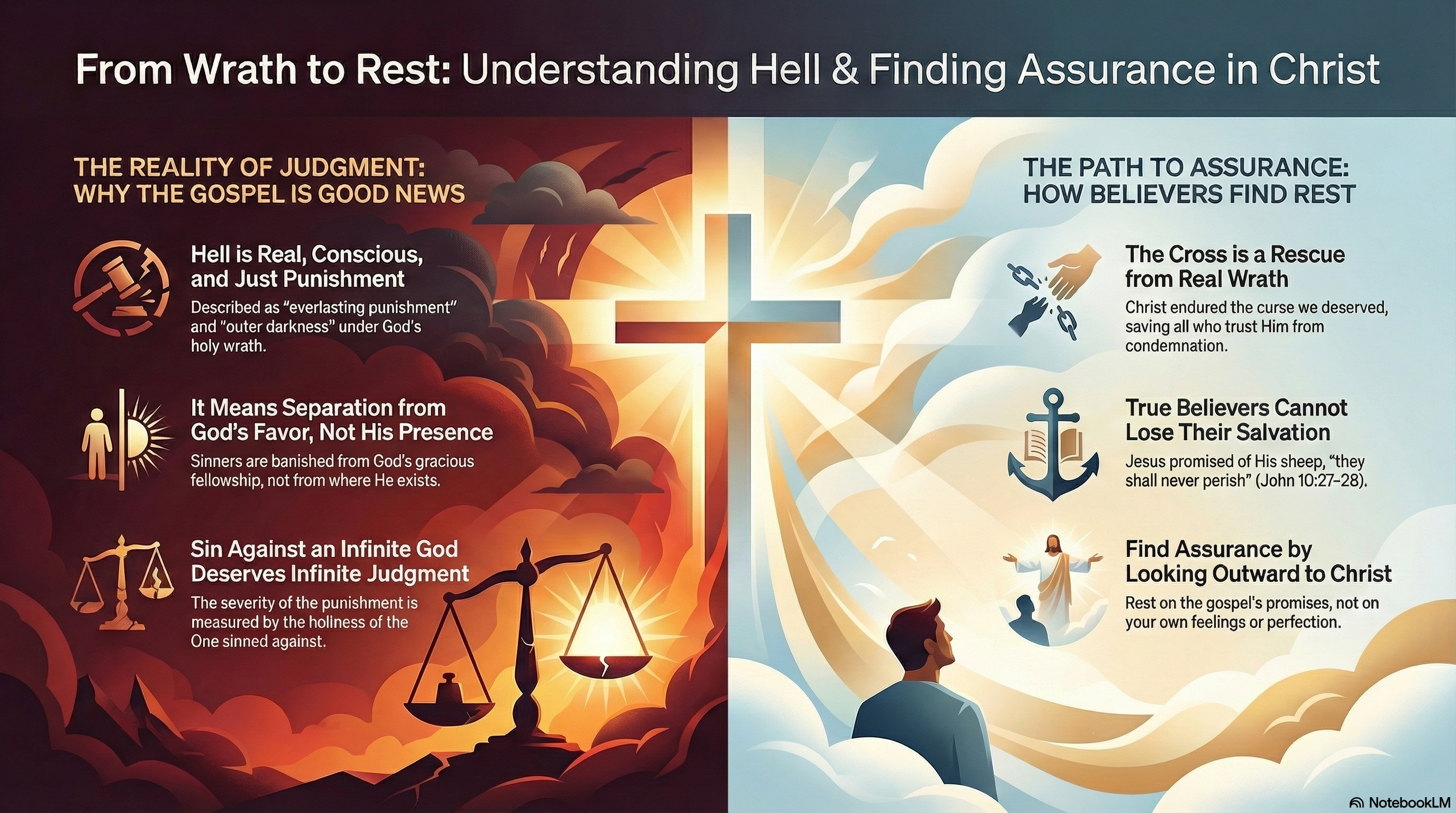
The Bible describes hell as **real, conscious, and just punishment** under the holy wrath of God.
Jesus Himself warns:
> “**And these shall go away into everlasting punishment: but the righteous into life eternal.**” (Matthew 25:46)
Other clear descriptions include:
* “**Depart from me**” (Matthew 7:23) — exclusion from fellowship with Christ
* “**outer darkness**” (Matthew 22:13) — shame and misery
* “**the lake which burneth with fire and brimstone**” (Revelation 21:8) — final judgment imagery pointing to real torment
* “**Who shall be punished with everlasting destruction from the presence of the Lord**” (2 Thessalonians 1:9)
The point is not to give us a tour of the afterlife, but to tell us the truth: **sin against the infinite, holy God deserves judgment**, and outside of Christ there is no refuge (John 3:36).
---
## 2) “Separation from God” — what it means (and what it doesn’t)
People often say hell is “separation from God.” That can be true **in one important sense**, but it needs careful definition.
### Not separation from God’s omnipresence
No creature can escape God’s presence in the sense of His being everywhere:
> “**Whither shall I go from thy spirit? or whither shall I flee from thy presence? If I ascend up into heaven, thou art there: if I make my bed in hell, behold, thou art there.**” (Psalm 139:7–8)
So hell is not “God stopped existing there.”
### Separation from God’s favorable presence and fellowship
“Separation” means being **cast out from God’s gracious face**, **banished from communion**, and left under **judicial wrath**:
> “**Your iniquities have separated between you and your God**” (Isaiah 59:2)
> “**Depart from me**” (Matthew 7:23)
Hell is not a place where God is absent; it is a place where God is present **as Judge**, not as reconciled Father.
---
## 3) After death: the intermediate state, then the final judgment
Scripture teaches that death brings immediate entry into a real condition—then history ends with resurrection and final judgment.
### Immediately after death
Believers go to be with Christ; unbelievers go to punishment, awaiting the final day (Luke 16:22–26; Luke 23:43; Philippians 1:23; 2 Corinthians 5:8). The Westminster Confession summarizes this plainly: the righteous are made perfect and received into heaven, while “the souls of the wicked are cast into hell,” and it explicitly rejects any third place (no purgatory).
Also:
> “**And as it is appointed unto men once to die, but after this the judgment**” (Hebrews 9:27)
### The last day
There will be bodily resurrection and open judgment:
> “**All that are in the graves shall hear his voice, And shall come forth; they that have done good, unto the resurrection of life; and they that have done evil, unto the resurrection of damnation.**” (John 5:28–29)
And the end is truly everlasting:
> “**the wicked… shall be cast into eternal torments… but the righteous… into everlasting life.**”
---
## 4) Why hell is everlasting
Scripture itself uses **everlasting / eternal** language repeatedly (Matthew 25:46; 2 Thessalonians 1:9; Revelation 14:11; Revelation 20:10).
We should be cautious and biblical here: the simplest answer is, **God says it is everlasting**, and God is righteous (Genesis 18:25). The moral weight of sin is measured not merely by the creature, but by the **holiness of the One sinned against** (Isaiah 6:3; Romans 3:23).
---
## 5) Hell explains the cross — and the cross explains hell
If hell is real, then Christ’s atonement is not a vague inspiration; it is a rescue from real wrath.
* We deserve condemnation (Romans 3:19–20).
* Christ bore the curse:
> “**Christ hath redeemed us from the curse of the law, being made a curse for us**” (Galatians 3:13)
And at the cross we hear the awful cost:
> “**My God, my God, why hast thou forsaken me?**” (Matthew 27:46)
This does not mean the Trinity was broken. It means the Son, as our Substitute, endured judgment so that sinners who trust Him can truly say:
> “**Being now justified by his blood, we shall be saved from wrath through him.**” (Romans 5:9)
---
## 6) Can you lose salvation? (Election and perseverance)
Many struggle here because they see real sin, real fear, and real warning passages. Reformed theology makes a crucial distinction:
* **Some are in the visible church** (outwardly connected to the people of God) and can fall away outwardly (1 John 2:19).
* **All who are truly united to Christ** will be kept by God and will persevere.
Jesus promises:
> “**My sheep hear my voice… and they shall never perish**” (John 10:27–28)
Westminster states it directly: those accepted in Christ “can neither totally nor finally fall away from the state of grace… and be eternally saved.”
And it grounds perseverance not in our independent willpower, but in God’s unchangeable love, Christ’s intercession, and the Spirit’s work.
### But what about backsliding and seasons of darkness?
Real believers can fall into grievous sin for a time, lose joy and comfort, and come under fatherly chastening—yet God restores them.
That’s why David can pray after terrible sin, “**Restore unto me the joy of thy salvation**” (Psalm 51:12)—not “re-save me,” but restore joy and fellowship.
---
## 7) How can a believer be assured of election?
Reformed assurance does **not** tell you to stare into God’s secret decree. It tells you to look to **Christ in the gospel**, and to see the Spirit’s work in your life.
Westminster gives a very pastoral guardrail: the doctrine of predestination must be handled “with special prudence and care,” so that people—by attending to God’s revealed will—“may, from the certainty of their effectual vocation, be assured of their eternal election.”
Scripture itself commands this kind of earnest diligence:
> “**Give diligence to make your calling and election sure**” (2 Peter 1:10)
> “**These things have I written unto you that believe… that ye may know that ye have eternal life**” (1 John 5:13)
### What assurance is (and isn’t)
Westminster says assurance is not “a bare conjectural and probable persuasion,” but can be an “infallible assurance of faith,” resting on God’s promises, the inward evidences of grace, and the Spirit’s witness.
It also says assurance can be “shaken, diminished, and intermitted,” yet the believer is never utterly left without God’s preserving work.
### A simple, biblical pathway for the anxious Christian
1. **Look outward to Christ, not inward first.**
> “**Him that cometh to me I will in no wise cast out**” (John 6:37)
2. **Rest on the promise of the gospel.**
> “**Believe on the Lord Jesus Christ, and thou shalt be saved**” (Acts 16:31)
3. **Examine for real evidences of grace (without perfectionism).**
> “**Examine yourselves, whether ye be in the faith**” (2 Corinthians 13:5)
> Do you hate your sin? Do you desire Christ? Do you cling to Him when you fall?
4. **Use the ordinary means of grace.**
Sit under faithful preaching (Romans 10:17), pray (Hebrews 4:16), live in the fellowship of the church (Acts 2:42), and receive the sacraments rightly as Christ’s appointed helps (1 Corinthians 11:28).
---
## 8) A clear gospel you can share (and preach to yourself)
God is holy (Isaiah 6:3). We are sinners and cannot justify ourselves (Romans 3:19–24). Jesus Christ, God’s Son, lived without sin, died for sinners, and rose again (1 Corinthians 15:3–4). God now commands all men to repent and believe the gospel (Mark 1:15). Every sinner who comes to Christ will be received:
> “**Whosoever shall call upon the name of the Lord shall be saved.**” (Romans 10:13)
If you want a one-sentence anchor for a troubled heart, take this:
> “**Looking unto Jesus the author and finisher of our faith**” (Hebrews 12:2)